

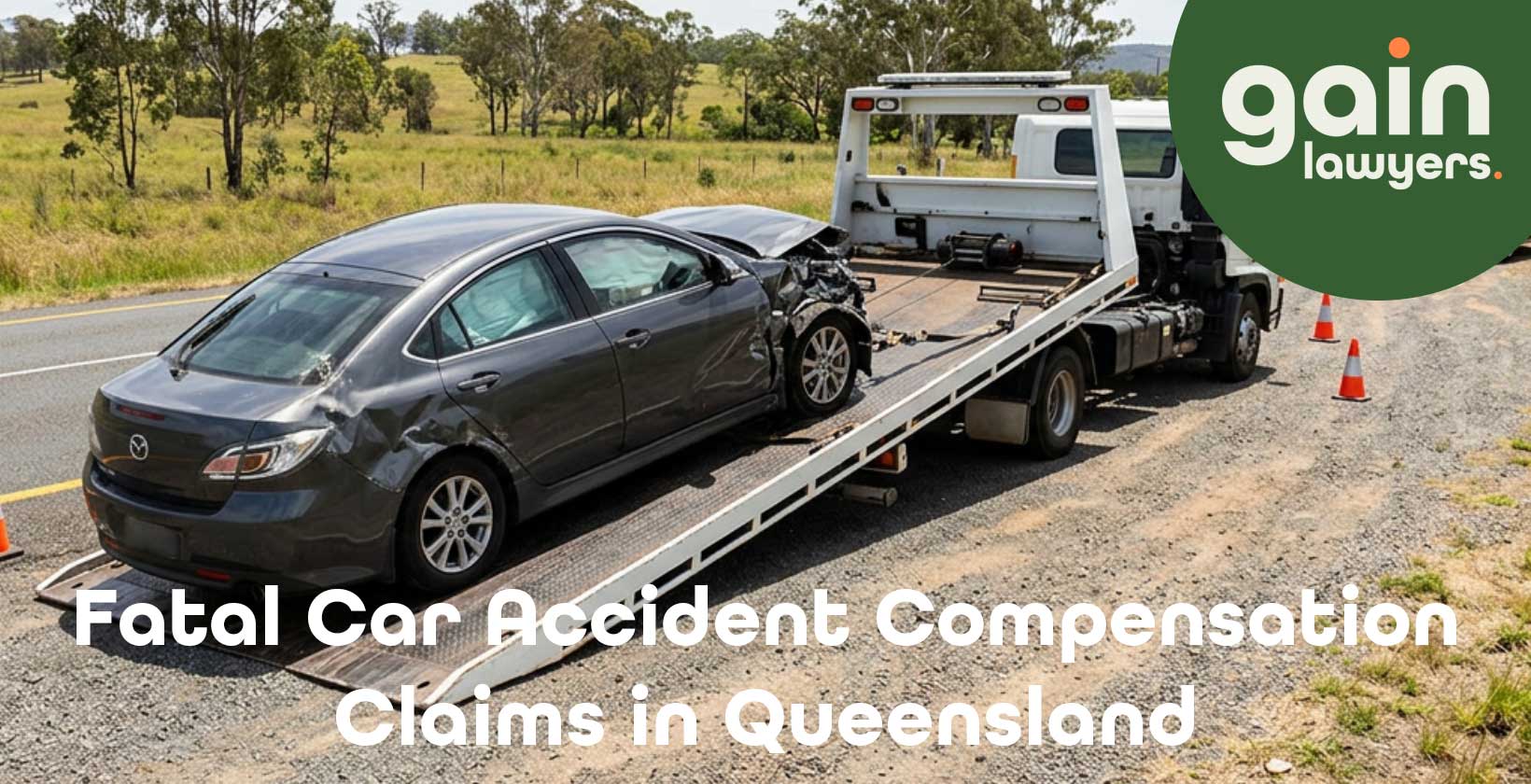
A fatal car accident claim in Queensland is a CTP insurance claim for dependency and estate damages brought by the family of a person killed in a motor vehicle accident caused by another party's negligence. Fatal car accident claims are pursued through the at-fault driver's Compulsory Third Party (CTP) insurer under the Motor Accident Insurance Act 1994 (Qld), and operate within the same scheme that handles non-fatal motor vehicle accident compensation claims across Queensland.
- Who can claim compensation after a fatal car accident depends on their relationship to the deceased and whether they were financially or materially dependent on them. Dependants (including a spouse, de facto partner, children and other family members who can show actual dependency) can bring a wrongful death “dependency” claim under Part 10 of the Civil Proceedings Act 2011 (Qld), with damages assessed in accordance with the Civil Liability Act 2003 (Qld), for loss of financial support, loss of domestic and care services, and related losses. Through the executor or administrator, the deceased’s estate can separately recover things like funeral expenses, medical costs incurred before death, and limited damages for the deceased’s pain and suffering, where a cause of action existed before death. Family members who suffer a diagnosed psychiatric injury because of the death or the accident itself may also be able to pursue a separate nervous shock claim.
Fault in a fatal car accident claim requires proof that another person's negligence caused the accident and the death. Where the deceased was partly responsible, contributory negligence reduces the compensation payable. Where the deceased was the sole driver, a CTP claim is generally unavailable unless a third party (such as a vehicle manufacturer, roads authority, or unidentified driver) contributed to the accident. Claims involving uninsured or unidentified vehicles are handled by the Nominal Defendant.
The average payout for a fatal car accident claim in Queensland is approximately $600,000 to $700,000 for dependency claims, with claims involving high-income earners or multiple young dependants regularly exceeding $1 million. The Notice of Accident Claim Form (Fatal Injury) must be lodged within 9 months of the accident, and court proceedings must be commenced within 3 years.
Queensland recorded 307 road fatalities in 2025, the highest annual toll in 16 years, with a fatality rate of 5.4 per 100,000 population ranking fourth-highest among Australian states.
What is a fatal car accident claim?
A fatal car accident claim is a compensation claim made by the dependants or estate of a person killed in a motor vehicle accident caused by another driver's negligence. In Queensland, fatal car accident claims are pursued through the at-fault driver's Compulsory Third Party (CTP) insurer under the Motor Accident Insurance Act 1994 (Qld), the same scheme that handles non-fatal car accident compensation claims. Fatal car accident claims sit within the broader framework of fatal accident claims in Queensland, which also covers fatalities arising from workplace incidents, public liability accidents, and medical negligence.
Two categories of claim typically arise after a fatal car accident in Queensland. Dependants of the deceased (usually a spouse, de facto partner, children, or others financially dependent on the deceased) can claim for the loss of financial support and services they would have received. The deceased's estate can separately recover funeral expenses, medical costs incurred before death, and certain other losses. Family members who suffer a recognised psychiatric injury as a result of the death may also have a separate nervous shock claim against the same CTP insurer.
Fatal car accident claims in Queensland arise across a range of scenarios, including:
- A driver killed in a multi-vehicle collision where another driver was at fault
- A passenger killed due to the negligence of the driver of their own or another vehicle
- A pedestrian struck and killed by a motor vehicle
- A cyclist hit and killed by a motor vehicle
- A fatality caused by a hit-and-run or unidentified vehicle
The immediate priority after any fatal car accident is preserving evidence and reporting the accident to police. Families should photograph the scene where possible, collect contact details of any witnesses, and notify the CTP insurer promptly. A certified copy of the death certificate should be obtained as early as possible. The full set of immediate actions families should take after a car accident applies equally to fatal cases, with the additional requirement that a coronial investigation will typically run in parallel.
Who pays compensation in a fatal car accident claim?
Compensation in a fatal car accident claim is typically paid by the CTP (Compulsory Third Party) insurer of the vehicle driven by the at-fault party. Every registered vehicle in Queensland carries a CTP policy as part of its registration, and that policy responds when the vehicle's driver causes injury or death to another road user. As a mandatory, registration-linked scheme, CTP in Queensland covers a driver’s legal liability for personal injuries caused to others in a motor vehicle accident, ensuring injured parties can claim compensation while excluding property damage.
Where the at-fault vehicle was uninsured at the time of the fatal accident, or where the vehicle that caused the fatal accident cannot be identified (for example in a hit-and-run), compensation is paid by the Nominal Defendant, a statutory body that stands in the place of a CTP insurer in those circumstances. The compensation entitlements available through the Nominal Defendant are largely the same as a standard CTP claim, though stricter notice timeframes apply.
Who can claim compensation after a fatal car accident?
The people who can claim compensation after a fatal car accident in Queensland are the deceased's dependants and the legal representative of the deceased's estate. Dependency claims and estate claims are two separate types of fatal car accident claim, with different rules about who has standing and what can be recovered.
A dependant in a fatal car accident claim is generally a person who relied on the deceased for financial support or services at the time of death. Under the Civil Proceedings Act 2011 (Qld), the categories of person who may bring a dependency claim after a fatal car accident typically include the following.
- A spouse or de facto partner of the deceased (where the relationship met the qualifying duration)
- Children of the deceased, including stepchildren and adopted children
- Parents and grandparents of the deceased
- Other family members who can demonstrate genuine financial dependency on the deceased
Only one action can be brought on behalf of all dependants of the deceased. Where there are multiple dependants any settlement sums must then be apportioned between each dependant.
Dependency in a fatal car accident claim is assessed on the actual relationship and financial reality at the date of death, not on a fixed list of relationships. A claim by a financially independent adult child, for example, is unlikely to succeed, while a claim by a non-married long-term partner with shared finances may be straightforward.
The deceased's estate in a fatal car accident claim is represented by the executor named in the will, or by an administrator appointed by the court if the deceased died without a will. The estate can recover certain losses suffered by the deceased before death and expenses incurred as a result of the death, separately from any dependency claim.
A third category of claimant exists in fatal car accident matters where a close family member suffers a recognised psychiatric injury as a result of the death. These nervous shock claims are pursued separately under the same CTP scheme, and require both a qualifying relationship to the deceased and medical evidence of a diagnosed psychiatric condition.
How does fault work in fatal car accident claims?
Fault in a fatal car accident claim under Queensland's Compulsory Third Party (CTP) scheme requires the family to prove that another person's negligence caused the accident and the resulting death. The Motor Accident Insurance Act 1994 (Qld) only responds where the death was caused, wholly or partly, by the wrongful act or omission of a person other than the deceased driver. Speed, right of way, traffic signal compliance, and each driver's opportunity to avoid the collision are typical factors weighed in the determination of fault for any motor vehicle accident claim, including fatal claims.
Proving fault in a fatal car accident claim generally involves establishing that another driver owed a duty of care, breached that duty, and that the breach caused the fatal accident. Evidence usually comes from the police investigation report, witness statements, expert accident reconstruction, vehicle inspection reports, and any available CCTV or dashcam footage. The coronial process can also produce useful evidence in fatal car accident cases, though coronial findings do not determine civil liability.
What if the deceased was partly at fault?
A fatal car accident claim can still succeed where the deceased was partly at fault, but the compensation payable to the family will be reduced to reflect the deceased's share of responsibility for the accident. This reduction is known as contributory negligence, and it operates the same way in fatal car accident claims as it does in non-fatal motor vehicle injury claims.
Common examples of contributory negligence include the deceased not wearing a seatbelt at the time of the collision, driving under the influence of alcohol or drugs, exceeding the speed limit, or contributing to the collision through their own driving conduct. The reduction is expressed as a percentage and applied to the total damages assessed. A finding of 25% contributory negligence, for example, reduces the family's compensation by a quarter.
What if the deceased was the only driver involved in the fatal accident?
A fatal car accident claim against the deceased driver's own Compulsory Third Party (CTP) insurer is generally not available where the deceased was solely at fault and no other party contributed to the accident. Queensland's CTP scheme is fault-based and requires negligence by a person other than the injured driver, so a sole-at-fault driver's estate or dependants cannot claim against that vehicle's CTP policy.
In some apparent single-vehicle fatal accidents, however, another party's negligence may have caused or contributed to the accident.
Possible pathways in these circumstances include:
- A claim against a vehicle manufacturer or repairer where a defect caused loss of control of the vehicle
- A claim against a roads authority where negligent road design or maintenance contributed to the fatal accident
- A claim against a passenger whose conduct (such as interfering with the steering or vehicle controls) caused the accident
- A Nominal Defendant claim where another unidentified vehicle caused the fatal accident but did not stop
These pathways depend on the specific circumstances of the fatal accident and require evidence that someone other than the deceased driver was negligent. Families uncertain whether a fatal car accident claim is possible after an apparent single-vehicle accident should obtain legal advice before assuming no claim exists.
What compensation is available in a fatal car accident claim?
The compensation available in a fatal car accident claim in Queensland is a lump sum covering dependency damages paid to qualifying family members and estate damages paid to the deceased's estate, assessed under the Civil Proceedings Act 2011 (Qld) and the Civil Liability Act 2003 (Qld). Damages fall into two main categories: dependency damages paid to qualifying family members, and estate damages paid to the deceased's estate.
Dependency damages compensate the deceased's family for the financial and practical losses they suffer as a result of losing the deceased's contribution to the household. The four main heads of dependency damage in a fatal car accident claim are.
- Loss of financial support: Loss of financial support refers to the income, earnings, and other financial contributions the deceased would have provided to the family over their working life.
- Loss of services: Loss of services means the value of household services, childcare, home maintenance, and other practical contributions the deceased would have provided.
- Loss of superannuation: The superannuation entitlements the deceased would have accrued and that the family would have benefited from.
- Loss of consortium: Loss of consortium refers to limited damages available for the loss of the deceased's companionship, care and affection, intimate relationship (in the case of partners), or parental guidance (in the case of children). Damages in this category are typically modest.
Estate damages compensate the deceased's estate for losses suffered before death and expenses arising from the death. The estate can recover reasonable funeral and burial expenses, the cost of medical treatment provided to the deceased between the accident and the death, and limited general damages for pain and suffering where the deceased survived for a period before dying.
Family members who suffer a recognised psychiatric injury as a result of the fatal accident may also recover separate damages for that injury, including general damages and any economic loss flowing from the psychiatric condition. These nervous shock damages are pursued as part of the same Compulsory Third Party (CTP) claim but assessed separately from dependency and estate damages.
Fatal claim values are driven by the deceased's projected lifetime earnings, the number and age of dependants, the years of expected dependency, and the value of household services the deceased would have provided. Because these factors vary widely, fatal car accident claim payouts typically range from approximately $50,000 for claims without financial dependants to $3 million where the deceased was a young high-income earner with multiple young dependants. Fatal claims do not follow the severity-based motor vehicle claim payout averages used for standard injury claims. Dependency damages are assessed on the deceased's economic contribution to the family rather than on the personal injury heads of damage that drive non-fatal CTP claim values.
How does the claim process work for a fatal car accident?
The claim process for a fatal car accident in Queensland follows six main stages, from reporting the accident to settlement or court proceedings. Fatal car accident claims involve additional procedural requirements not present in standard injury claims, including a fatal-specific version of the Notice of Accident Claim Form and detailed dependency evidence.
The 6 key stages of a fatal car accident claim are outlined below.
- Report the accident to police. All fatal car accidents in Queensland must be reported to police. Families should also photograph the scene where possible, collect contact details of any witnesses, and notify the deceased's Compulsory Third Party (CTP) insurer promptly. The police investigation report and any coronial findings become key evidence, though the coronial process runs separately and on its own timeframe.
- Instruct a personal injury lawyer. Fatal car accident claims involve complex dependency calculations and multiple potential claimants. Most personal injury lawyers in Queensland handle fatal car accident claims on a No Win No Fee basis, meaning the family does not pay legal fees unless the claim succeeds.
- Lodge the Notice of Accident Claim Form (Fatal Injury). The CTP claim formally begins when the family lodges the Notice of Accident Claim Form (NOAC) with the at-fault driver's CTP insurer, using the Fatal Injury variant (MAIC Form F4) prescribed by the Motor Accident Insurance Commission. The fatal injury version of the Notice of Accident Claim has two parts. Part A covers funeral and other expenses only, while Part B must also be completed for dependency claims. The form requires a certified copy of the death certificate, the police accident report reference number, and a marriage certificate where the claimant is the deceased's spouse.
- Insurer investigation and liability response. The CTP (Compulsory Third Party) insurer must contact the claimant within 14 days of receiving the Notice of Accident Claim form to confirm whether it constitutes a satisfactory notice. The insurer then investigates the claim, assesses liability, and may request additional evidence including coronial documents and financial records.
- Gather dependency and loss evidence. Fatal car accident claims require detailed evidence of the deceased's earnings history, projected future income, superannuation, household contributions, and the financial circumstances of each dependant. Forensic accountants are often engaged to prepare these calculations.
- Compulsory conference, settlement, or court proceedings. Once evidence is gathered, the parties attend a compulsory conference to negotiate settlement. Where settlement is not reached at conference, the family can commence court proceedings. Court proceedings in a fatal car accident claim means filing a claim in court, not necessarily proceeding to trial.
What are the time limits for fatal car accident claims?
The main time limit for a fatal car accident claim in Queensland is 9 months from the date of the accident to lodge the Notice of Accident Claim Form (Fatal Injury) with the CTP insurer, and 3 years from the date of the accident to commence court proceedings. Fatal car accident claims involving an unidentified vehicle must be lodged with the Nominal Defendant within 3 months. Missing these deadlines can result in the claim being rejected or permanently barred.
Fatal car accident claims lodged through a lawyer have an additional timing requirement. The Notice of Accident Claim Form (Fatal Injury) must be given to the Compulsory Third Party (CTP) insurer within 1 month of the first legal consultation, though this does not extend the 9-month outer limit. Late lodgement of a fatal car accident claim against an identified vehicle does not automatically bar the claim, but the claimant must provide a reasonable excuse for the delay under s 37(3) of the Motor Accident Insurance Act 1994 (Qld).
Where a fatal car accident involved an unidentified vehicle (for example a hit-and-run), stricter timeframes apply. The Notice of Accident Claim Form (Fatal Injury) must be lodged with the Nominal Defendant within 3 months of the date of the accident unless there is a reasonable excuse for the delay. The nominal defendant is a statutory body that acts as a “back up” insurer where no CTP insurer is present. In all circumstances, fatal car accident claims against the Nominal Defendant must be lodged within 9 months of the accident or the claim is permanently barred.
Court proceedings in a fatal car accident claim must generally be commenced within 3 years of the date of the accident. The car accident time limits that apply to standard motor vehicle injury claims also apply to fatal claims, including the limited circumstances in which a court may grant an extension. Where the claimant is a child, the 3-year limitation period generally does not begin to run until the child turns 18.
How common are fatal car accidents in Queensland?
Queensland recorded 307 road fatalities in 2025, the highest annual road toll in 16 years and a 40% increase from the record low of 219 deaths in 2019. The state has now recorded two consecutive years above 300 fatalities for the first time since 2008–2009, reversing a sustained decline that lasted most of the previous decade.
Queensland's fatality rate of 5.4 deaths per 100,000 population ranks fourth-highest among Australian states and territories, and sits 32% above the national average of 4.1. Only the Northern Territory (14.4), Tasmania (7.6), and Western Australia (6.0) recorded higher rates in 2025. In absolute numbers, Queensland's 307 fatalities placed second behind New South Wales (355), despite Queensland having a smaller population. The Queensland government tracks annual road accident statistic and records fatalities across the state to evaluate the effectiveness of road safety programs, identify high-risk locations, and inform the development of new measures aimed at improving road conditions and reducing harm for all road users.
Fatal car accidents in Queensland are disproportionately concentrated in regional and rural areas, where higher speed limits, longer distances, and reduced access to emergency medical care contribute to a higher fatality rate than in metropolitan Brisbane and the Gold Coast. The most common contributing factors in fatal road accidents across Queensland include speeding, driver fatigue, alcohol and drug impairment, distracted driving, and failure to wear a seatbelt.
What if the driver who caused the fatal accident was uninsured or unidentified?
Fatal car accident claims in Queensland can still proceed where the at-fault vehicle was uninsured or where the vehicle that caused the fatal accident cannot be identified. In these circumstances, the claim is made against the Nominal Defendant, a statutory body established under the Motor Accident Insurance Act 1994 (Qld) that stands in the place of a Compulsory Third Party (CTP) insurer.
The Nominal Defendant exists because Queensland's CTP scheme is tied to vehicle registration. When a vehicle is unregistered, it carries no CTP policy, which means there is no insurer for the family to claim against. The Nominal Defendant fills that gap by acting as the insurer “of last resort”, funded by a levy on all CTP premiums paid by registered vehicle owners in Queensland. The Nominal Defendant also handles claims where the at-fault vehicle cannot be identified at all (for example a hit-and-run where the driver fled the scene and was never found).
The compensation entitlements available through a Nominal Defendant fatal car accident claim are largely the same as a standard CTP claim, including dependency damages, estate damages, and funeral expenses. The main difference between a standard fatal car accident claim and a Nominal Defendant claim is the stricter lodgement timeframe. Fatal car accident claims involving an unidentified vehicle must be lodged with the Nominal Defendant within 3 months of the date of the accident, compared to 9 months for a claim against an identified vehicle's CTP insurer. The 9-month outer limit for Nominal Defendant claims is a hard bar with no exception, meaning the claim is permanently lost if the deadline is missed regardless of the reason for the delay.
Families who suspect the fatal accident may have involved another vehicle that left the scene should report this to police immediately and gather any available evidence (witness descriptions, CCTV footage, paint transfer on the deceased's vehicle) to support a Nominal Defendant claim.
What funeral and burial expenses are recoverable in a fatal car accident claim?
The funeral and burial expenses recoverable in a fatal car accident claim in Queensland typically include the cost of the funeral service, burial or cremation fees, a coffin or casket, headstone or memorial plaque, flowers, death notices, and reasonable costs associated with a wake or reception. These expenses are recovered by the deceased's estate as part of the Compulsory Third Party (CTP) claim. Where the deceased died away from their home (for example during interstate or regional travel), repatriation costs to return the deceased's body to the family may also be recoverable.
Funeral expenses are one of the most straightforward components of a fatal car accident claim because they do not require the complex dependency calculations that other forms of compensation involve. The CTP insurer assesses funeral expenses on a reasonableness standard. The insurer is not required to cover extravagant or unusually expensive funeral arrangements, but the standard is applied practically and recognises that families make funeral decisions during a period of acute grief.
Receipts and invoices for all funeral-related expenses should be kept and provided to the CTP insurer as part of the fatal car accident claim. The Notice of Accident Claim Form (Fatal Injury) includes a specific section for itemising funeral costs, and Part A of the form can be completed for funeral expenses alone without lodging a full dependency claim under Part B.