

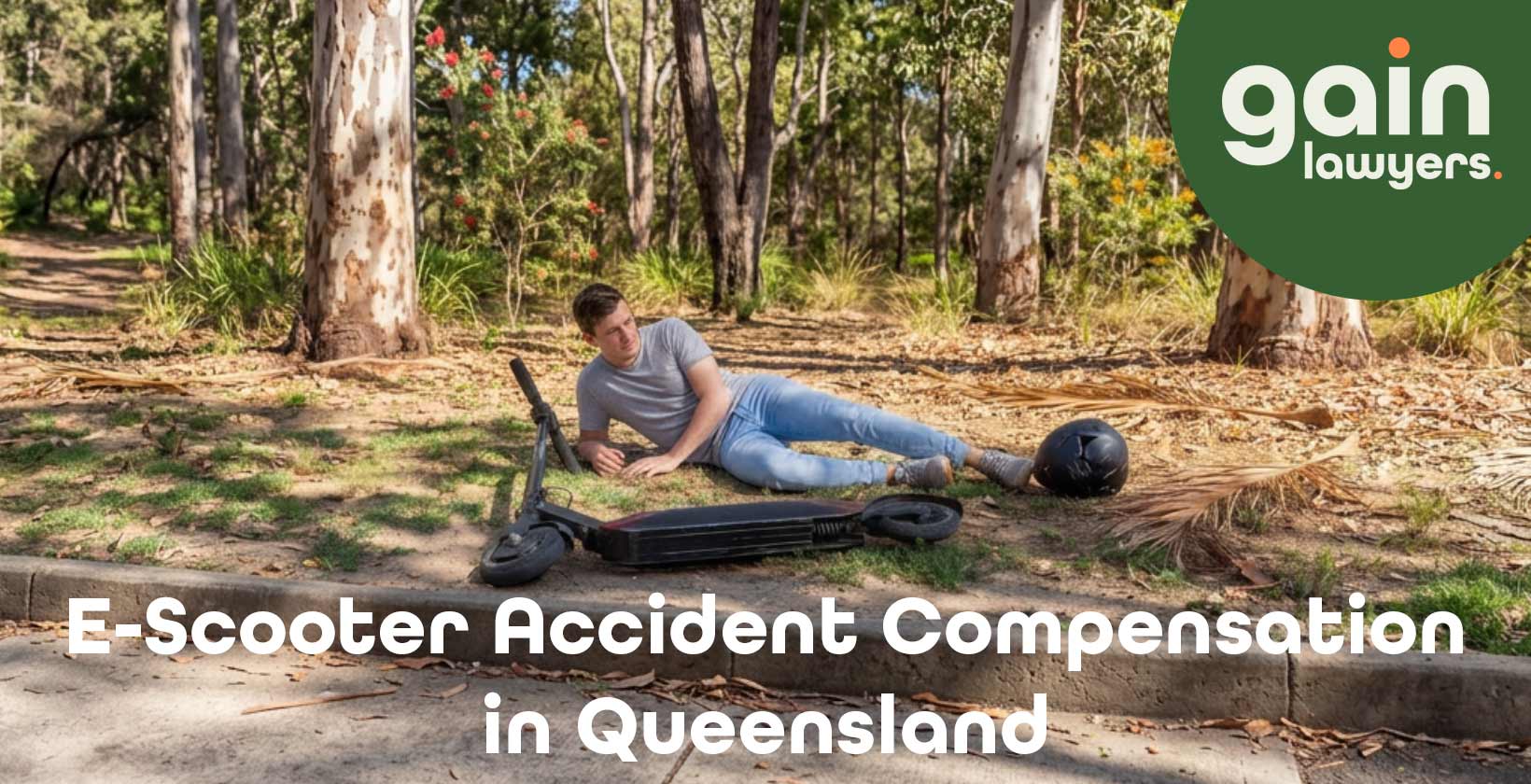
E-scooter accident compensation is a monetary payout awarded to a person injured in an incident involving an electric scooter or personal mobility device, covering medical expenses, lost income, rehabilitation, and care needs. The legal framework for an e-scooter accident claim in Queensland is one of two pathways depending on whether a motor vehicle was involved. A CTP claim is brought under the Motor Accident Insurance Act 1994 (Qld) where a rider was hit by a motor vehicle, and a public liability claim is brought under the Personal Injuries Proceedings Act 2002 (Qld) and Civil Liability Act 2003 (Qld) in most all other scenarios.
The two-pathway structure exists because e-scooters are classified as personal mobility devices (PMDs), not motor vehicles, meaning they do not carry CTP insurance and their riders do not access a no-fault compensation scheme. The practical consequence is that two riders with identical injuries can face very different recovery prospects depending on whether their accident involved a motor vehicle.
An e-scooter accident compensation claim can be brought by a rider hit by a motor vehicle, a pedestrian or cyclist hit by an e-scooter rider, a rider injured in a single-vehicle crash, or dependants of a person killed in an e-scooter accident. Defendants include the at-fault vehicle's CTP insurer in motor vehicle cases, the rider personally (plus parents where the rider is a minor and the hire operator where a hire scooter was involved) in collisions with pedestrians or cyclists, and the manufacturer, road authority, or hire operator in single-vehicle crashes. The most common e-scooter accident injuries include head and traumatic brain injuries, facial and dental injuries, wrist and arm fractures, spinal injuries, and burns from lithium-ion battery fires.
E-scooter accident compensation payouts in Queensland typically range from approximately $3,000 to $1 million depending on injury severity, with catastrophic cases reaching $2 million or more in rare cases involving lifetime care. Lifetime support under the National Injury Insurance Scheme Queensland (NIISQ) is available only where a motor vehicle was involved, leaving riders catastrophically injured in single-vehicle crashes outside both CTP and NIISQ coverage.
Fault in an e-scooter accident is determined under the Queensland Road Rules and the principles of negligence, with compensation reduced where contributory negligence is established through failure to wear a helmet, excessive speed, or riding in prohibited areas. The time limits for an e-scooter accident claim require notice of the claim to be given within 9 months of the accident, or later with a reasonable excuse for the delay, and court proceedings must be commenced within 3 years. Nominal Defendant claims for unidentified motor vehicles at fault are subject to a shorter 3-month notice period and if a compliant claim is not served within 9 months of the accident, the claim is extinguished at that point. The Queensland Government enacted the first stage of e-mobility law reform from 1 July 2026 in response to the parliamentary inquiry into e-mobility safety, but the inquiry's recommendation of mandatory CTP insurance for higher-powered devices was not implemented, and the compensation framework for e-scooter accidents is therefore unchanged.
What is e-scooter accident compensation?
E-scooter accident compensation is a monetary payout awarded to a person injured in an incident involving an electric scooter or personal mobility device, intended to cover financial losses such as medical expenses, lost income, and recovery costs. In Queensland, the legal framework that applies to an e-scooter accident claim depends on whether a motor vehicle was involved in the crash, because e-scooters themselves are not registered vehicles and do not carry Compulsory Third Party (CTP) insurance.
E-scooter accident claims in Queensland fall into two distinct legal frameworks. Where the injured person was hit by a motor vehicle, the claim is made against the motor vehicle's CTP insurer under the Motor Accident Insurance Act 1994 (Qld), in the same way as any other motor vehicle accident claim. Where no motor vehicle was involved (for example a pedestrian hit by an e-scooter rider, an e-scooter rider injured by a road defect, or an e-scooter rider injured by their own loss of control) the claim follows the public liability framework under the Personal Injuries Proceedings Act 2002 (Qld) and the Civil Liability Act 2003 (Qld), which produces compensation through different procedural channels and against different defendants.
E-scooter accident compensation forms part of the broader Queensland system for motor vehicle accident compensation when a motor vehicle is involved in the crash, but operates outside that system entirely when the only parties involved are e-scooter riders, pedestrians, or static infrastructure. The split framework is the single most important legal feature of e-scooter compensation in Queensland, because it determines who the injured person claims against, what statutory deadlines apply, what evidence the claim depends on, and what compensation is realistically recoverable. The framework split also creates a substantial gap in protection for people injured in private e-scooter incidents, because the public liability pathway depends on the at-fault party having either personal assets or applicable insurance — and e-scooter riders frequently have neither.
The compensation available under either framework is assessed as common law damages, which means the amount is based on the injured person's actual losses rather than a fixed schedule of statutory benefits. E-scooter accident compensation covers personal injury only. It does not cover the cost of repairing or replacing the e-scooter itself, the motor vehicle involved in the crash, any property being carried, or any other non-injury losses.
Are e-scooters classified as motor vehicles in Queensland?
No, e-scooters are not classified as motor vehicles in Queensland. They are classified as personal mobility devices (PMDs) under the Transport Operations (Road Use Management—Road Rules) Regulation 2009 (Qld), which sits them outside the motor vehicle category for registration, licensing, and CTP insurance purposes. The PMD classification applies to devices that are propelled by an electric motor, fall within prescribed dimension limits, weigh no more than 60 kilograms without a rider or load, have an effective braking system, and are not designed as a pedal-powered vehicle. PMDs are subject to a maximum speed limit of 25 kilometres per hour under the Regulation, and riders must be at least 16 years old, or at least 12 and supervised by an adult.
The PMD classification has three significant consequences for compensation claims. First, e-scooters do not require registration or CTP insurance, which means there is no insurance scheme attached to the e-scooter itself for an injured person to claim against. Second, e-scooter riders were historically not required to hold a driver licence, though from 31 August 2026 riders must be at least 16 years old and hold a minimum of a learner licence. The licensing requirement does not attach registration or CTP insurance obligations to the deviceThird, a PMD rider is legally treated as a "rider" rather than a "pedestrian" for the purposes of the Queensland Road Rules, and most of the rules that apply to drivers apply to PMD riders in the same way, including traffic light compliance, give-way rules, speed limits, and the passing distance obligations owed to cyclists and other PMD riders.
Power-assisted bicycles (bicycles with an electric motor that assists pedalling up to 25 kilometres per hour, at no more than 250 watts of continuous power) are legally classified as ordinary bicycles in Queensland and follow the same road rules and compensation framework that apply to any other cyclist. Throttle-controlled or higher-powered electric bikes that exceed those thresholds are classified as personal mobility devices alongside e-scooters and follow the personal mobility device framework. Many e-bike riders do not know which side of the threshold their bike sits on because the labelling at point of sale is often unclear, and e-bike accident claims frequently run into problems where a rider has assumed their bike falls into one category when it actually falls into the other.
Who can claim e-scooter accident compensation in Queensland?
A person injured in an e-scooter accident can typically claim compensation in Queensland where the injury was caused by another party's negligence, with the available claim pathway depending on whether the injured person was riding the e-scooter, hit by an e-scooter rider, or injured by a defective e-scooter or infrastructure failure. The identity of the claimant and the cause of the accident together determine which of several statutory frameworks applies to the claim.
The three categories of people who can claim e-scooter accident compensation in Queensland are set out in the sections below.
E-scooter riders injured by a motor vehicle
E-scooter riders injured by the negligence of a motor vehicle driver can claim compensation through the standard Compulsory Third Party (CTP) insurance scheme under the Motor Accident Insurance Act 1994 (Qld), in the same way as any other road user struck by a motor vehicle. This is the most legally straightforward scenario for e-scooter accident compensation because the motor vehicle carries CTP insurance by law, the scheme has mature procedural rules, and the injured rider is entitled to the same heads of damage as any other CTP claimant.
An e-scooter rider hit by a car at an intersection, struck while crossing a road, rear-ended while travelling in a shared lane, or knocked off by a car door opening into their path all claim compensation under the CTP framework against the at-fault vehicle's insurer. The rider does not deal with the driver or the insurer personally in practice, because the claim is typically run by the rider's own lawyer, and the statutory process under the Motor Accident Insurance Act 1994 (Qld) ends with either negotiated settlement, compulsory conference resolution, or court judgment.
Pedestrians and other road users hit by an e-scooter
Pedestrians struck by an e-scooter rider, cyclists knocked off their bike by an e-scooter rider, and other e-scooter riders hit in collisions with a second e-scooter follow a different legal framework because no motor vehicle is involved in the collision. These claims are public liability claims under the Personal Injuries Proceedings Act 2002 (Qld) and the Civil Liability Act 2003 (Qld), made against the at-fault e-scooter rider personally rather than against a CTP insurer.
The practical difficulty with claims against e-scooter riders is that most riders carry no insurance that covers the harm they cause to other people. Unlike motor vehicle drivers, e-scooter riders are not required to hold any form of third-party insurance, and home and contents insurance policies commonly exclude injuries caused by personal mobility devices. Where the rider is an adult with personal assets the injured person can pursue, a public liability claim can recover substantial compensation. Where the rider has no assets and no insurance, the injured person may find that a valid legal claim produces no practical recovery. A pedestrian struck by a minor riding an e-scooter has additional potential defendants, because parental liability and the family's home and contents insurance policy can extend coverage to injuries caused by the child, though the availability of parental coverage depends on the terms of the specific policy and the circumstances of the incident.
Hire e-scooter operators are a second potential defendant where the rider was using a hire scooter at the time of the collision. Hire operators use contractual terms that purport to shift liability to the rider and limit the operator's own exposure, but those contractual limitations can be challenged under the Australian Consumer Law where they are unconscionable, unfair, or fail to meet the consumer guarantee requirements. Hire operators can also be directly liable for injuries caused by defective or poorly maintained scooters, inadequate rider safety information, or failure to enforce the rules of the hire scheme.
E-scooter riders injured without another vehicle involved
E-scooter riders injured in single-vehicle crashes face the most difficult claim landscape in the e-scooter compensation framework. A single-vehicle crash is any incident where the rider loses control, hits a road defect, suffers a mechanical failure, collides with a stationary object, or is otherwise injured without another party being involved. No CTP insurer is available because no motor vehicle was involved, and the rider cannot claim against themselves. The available claim pathways depend entirely on whether an identifiable party other than the rider contributed to the crash.
Where the crash was caused by a defective e-scooter component (e.g. a brake failure, throttle malfunction, wheel or tyre defect, battery failure, or electrical fault), the rider may have a product liability claim against the manufacturer under the Australian Consumer Law, which provides consumer guarantees for goods that must be of acceptable quality and fit for purpose. Product liability claims against e-scooter manufacturers are procedurally distinct from CTP claims and follow a different evidentiary framework, typically requiring expert engineering evidence about the cause of the failure and the manufacturer's design or quality control decisions. Where the crash involved a hire scooter, the rider may also have a claim against the hire operator for failure to maintain the scooter in safe working order.
Where the crash was caused by a road or path defect (e.g. a pothole, raised drain cover, surface crack, missing signage, or inadequate road design), the rider may have a public liability claim against the road authority responsible for the location. State-controlled roads and major arterial routes are managed by the Department of Transport and Main Roads, while local roads, bikeways, and footpaths are typically the responsibility of the relevant local council. Road authority claims are particularly relevant for e-scooter riders because e-scooters have small wheels and limited suspension, which makes them more vulnerable to surface defects than cars or motorcycles, and the rider's injury from a defect that would be unremarkable for a larger vehicle can be catastrophic.
Where the crash cannot be attributed to any party other than the rider, there is typically no compensation pathway available, because negligence law requires an at-fault party against whom a claim can be made. A loss of balance, an unforced error, or a collision with a stationary object the rider failed to see all fall into this category. The absence of a fault-based defendant is one of the main reasons the parliamentary inquiry into e-mobility safety recommended substantive regulatory reform, though the first stage of reform enacted from 1 July 2026 did not address this compensation gap.
Who is responsible for an e-scooter accident compensation claim?
Responsibility for an e-scooter accident compensation claim in Queensland depends on the circumstances of the collision and can rest with the motor vehicle driver who hit the rider, the e-scooter rider whose negligence caused injury to someone else, the parents of a minor rider, the hire scheme operator for hire scooter crashes, the manufacturer of a defective e-scooter, or the road authority responsible for a defective road surface. E-scooter accident claims often involve more defendants than other motor vehicle accident claims because the absence of a single compulsory insurance scheme forces the injured person to identify every party whose negligence contributed to the injury and claim against whichever party has insurance or assets available.
The parties who can be held responsible for an e-scooter accident compensation claim in Queensland are set out in the sections below.
The motor vehicle driver and their CTP insurer
Where a motor vehicle was involved in the collision, the at-fault driver is the primary defendant and the claim is made against the vehicle's CTP insurer rather than against the driver personally. Where the at-fault motor vehicle cannot be identified (e.g. a hit and run) or is unregistered and uninsured, the claim is made against the Nominal Defendant in place of the missing insurer, following the process under Part 4 of the Motor Accident Insurance Act 1994 (Qld), including the shorter notice limits under section 37.
The e-scooter rider personally
Where the e-scooter rider is at fault and the injured party is a pedestrian, another e-scooter rider, a cyclist, or any other person hit by the rider, the claim is made against the rider personally as a public liability claim under the Personal Injuries Proceedings Act 2002 (Qld). The rider's personal liability is the legal basis for the claim, but the practical recovery depends on whether the rider has assets, insurance, or other means to satisfy a judgment. Most e-scooter riders do not carry any form of third-party liability insurance for injuries they cause to others, and home and contents insurance policies commonly exclude personal mobility devices from coverage. Where the rider has no insurance and no assets, the injured person may win the legal claim on the merits and still recover nothing in practice. This protection gap is one of the main reasons the parliamentary inquiry into e-mobility safety recommended mandatory insurance for higher-powered devices, a recommendation the government did not adopt in the 2026 reforms, which instead banned devices capable of exceeding 25 kilometres per hour.
Hire scheme operators
Where the e-scooter involved in the crash was a hire scooter, the hire operator (e.g. Beam, Lime, Neuron, Ride) can be liable for injuries to the rider or to anyone hit by the rider, in several distinct ways. The first is direct liability for defective or poorly maintained scooters, where the operator has failed to keep the scooter in safe working order and a mechanical failure has caused the crash. The second is liability for inadequate rider safety information, where the operator has failed to warn riders about the known risks of e-scooter use, the applicable road rules, or the specific hazards of the particular scooter model. The third is vicarious or contributory liability where the operator has knowingly hired scooters to riders who were intoxicated, underage, or otherwise not entitled to ride.
Hire operators use extensive contractual terms in their user agreements that purport to shift all liability to the rider and limit the operator's own exposure to the fullest extent permitted by law. Those contractual limitations are not always enforceable. The Australian Consumer Law provides consumer guarantees that cannot be contracted out of, including the guarantee that services be provided with due care and skill, and the unfair contract terms regime allows courts to strike out terms that create significant imbalances between the parties or are not reasonably necessary to protect the operator's interests. A hire operator that relies solely on its user agreement to avoid liability for a defective scooter or an inadequate safety briefing may find that the critical terms are unenforceable.
Parents of minor e-scooter riders
Where an e-scooter rider under 18 causes injury to another person, the parents or guardians of the minor may be liable for the harm in addition to the minor themselves. Parental liability in Queensland arises through several distinct legal mechanisms, including direct negligence by the parents (e.g. allowing a minor to ride an e-scooter without adequate supervision or failing to enforce safety rules), vicarious liability where the parent authorised or controlled the minor's conduct, and coverage under the family's home and contents insurance policy where the policy extends to harms caused by household members.
Home and contents insurance is often the most practical route to recovery where a minor has caused injury, because most parents do not have the personal assets needed to satisfy a substantial personal injury judgment. The availability of home and contents coverage depends on the specific policy terms, and many Queensland policies now expressly exclude personal mobility devices from third-party liability coverage, which has left a growing gap between the legal right to claim and the practical ability to recover. A pedestrian hit by a 13-year-old on an e-scooter who has no personal assets, uninsured parents, and no home and contents coverage for the incident may have a valid legal claim but no realistic prospect of recovery.
Manufacturers and road authorities
Where a defective e-scooter component caused the crash, the manufacturer of the component and potentially the retailer or importer of the e-scooter can be liable under the Australian Consumer Law. A claim of this kind requires evidence that the component was defective when it left the manufacturer's control and that the defect caused the injury, which typically depends on expert engineering evidence and often on preserving the defective component for forensic analysis. Battery fires in e-scooters have emerged as a specific product liability claims category in Queensland, with the Queensland Fire Department attending multiple fatal battery fire incidents involving e-mobility devices between March 2022 and July 2025.
Where a road or path defect caused the crash, the road authority responsible for the location can be liable under the Civil Liability Act 2003 (Qld) for the cost of the injuries. State-controlled roads are managed by the Department of Transport and Main Roads, local roads and footpaths are usually the responsibility of the relevant local council, and shared bikeways and pathways can fall under either jurisdiction depending on the specific location. Road authority claims are particularly relevant for e-scooter riders because the small wheel size and limited suspension of most e-scooters make them vulnerable to surface defects that a car or motorcycle would absorb without incident.
What are the most common causes of e-scooter accidents in Queensland?
The most common causes of e-scooter accidents in Queensland are collisions with motor vehicles, loss of control at speed, rider inexperience and intoxication, mechanical and battery failures, road and path surface defects, collisions with pedestrians on shared paths, and helmetless or non-compliant riding. Queensland Health data presented to the state parliamentary inquiry into e-mobility safety recorded more than 6,300 e-mobility related emergency department presentations in the year to March 2025, with more than 200 of those cases involving major trauma.
The 7 most common causes of e-scooter accidents in Queensland typically fall into the following categories.
- Collisions with motor vehicles at intersections and in traffic. E-scooter riders are often hit by cars turning across their path, merging into bike lanes, failing to see the rider at intersections, or opening doors into the rider's path. These collisions produce the most serious injury outcomes because the crash forces involved in any collision between a motor vehicle and an unprotected personal mobility device are significantly higher than collisions between two motor vehicles.
- Loss of control at speed on uneven surfaces. E-scooters have small wheels, limited suspension, and a high centre of gravity relative to the wheelbase, which makes them sensitive to surface irregularities that larger vehicles absorb without incident. A rider travelling at the legal 25 kilometre per hour limit can lose control on a road surface crack, a wet patch, loose gravel, or a small pothole, and the resulting crash often produces serious head, wrist, and facial injuries.
- Rider inexperience and intoxication. Many e-scooter crashes involve riders using a hire scooter for the first or second time, riders unfamiliar with the specific controls of a particular scooter model, or riders who have been drinking. Tourists riding hire scooters in unfamiliar environments, often at night and after alcohol consumption, represent a disproportionate share of e-scooter injury presentations at Queensland emergency departments.
- Mechanical failures and battery fires. Brake failures, throttle malfunctions, wheel and tyre defects, and battery failures produce a significant share of e-scooter crashes, particularly in hire scooters that receive heavy daily use and in privately owned scooters that have been modified or poorly maintained. Lithium-ion battery fires are an increasing concern, with the Queensland Fire Department responding to four fatal battery fire incidents involving e-mobility devices between March 2022 and July 2025.
- Road and path surface defects. Potholes, raised drain covers, surface cracks, tree root damage, loose gravel, wet leaves, and poorly maintained bikeways cause a disproportionate number of e-scooter crashes relative to other vehicle types. Road authority claims for e-scooter injuries often turn on whether the authority had actual or constructive knowledge of the defect and whether the defect was reasonably repairable within a relevant timeframe.
- Collisions with pedestrians on shared paths. E-scooters travelling at the 25 kilometre per hour legal limit are significantly faster than walking pace, and collisions between e-scooters and pedestrians on shared footpaths and pedestrian areas produce frequent injuries to both parties. A 12 kilometre per hour footpath speed limit was introduced from 1 July 2026 to address the pedestrian safety risk, a modified version of the parliamentary inquiry's recommendation of a 10 kilometre per hour limit.
- Helmetless or non-compliant riding. Riders who fail to wear a helmet, exceed the 25 kilometre per hour speed limit, ride in prohibited areas, ride under the legal age without adult supervision, or use modified scooters that exceed the legal specifications face both increased injury severity and significant contributory negligence exposure on any compensation claim they pursue. Helmet use is particularly variable among hire scooter users, who often do not carry their own helmet and do not receive one from the hire operator.
How is fault determined in an e-scooter accident claim?
Fault in an e-scooter accident claim is determined by establishing which party breached a legal duty of care owed to the injured person and whether that breach caused the injuries. The legal framework that applies to the fault analysis depends on whether the claim is a Compulsory Third Party (CTP) claim against a motor vehicle insurer or a public liability claim against an e-scooter rider, a hire operator, a manufacturer, or a road authority. Both frameworks apply the standard negligence principles under the Civil Liability Act 2003 (Qld), including the duty of care, breach, causation, and reasonable foreseeability, but the evidence used to establish fault often differs significantly between the two pathways.
Road rules for e-scooter riders in Queensland are set out in the Transport Operations (Road Use Management—Road Rules) Regulation 2009 (Qld), which treats e-scooters as personal mobility devices and imposes specific obligations on riders including mandatory helmet use, a 25 kilometre per hour maximum speed limit, a 12 kilometre per hour footpath speed limit, age and licensing requirements, and restrictions on where e-scooters can be ridden. A breach of any of these road rules by either an e-scooter rider or a motor vehicle driver is relevant evidence of negligence in a civil compensation claim, because breaches of safety regulations typically establish a failure to meet the standard of care owed to other road users.
What evidence is used in an e-scooter accident claim?
The evidence used to establish fault in an e-scooter accident claim is often more difficult to gather than the evidence in a standard motor vehicle accident claim, because e-scooters leave less physical evidence at the scene, are not subject to routine police crash investigation, and do not carry event data recorders of the kind found in modern cars.
The most important evidence categories for e-scooter accidents typically include the following items.
- Police reports and incident records. Serious e-scooter crashes attended by Queensland Police produce an incident report that establishes the time, location, parties, and basic circumstances of the collision. Less serious crashes are often not attended by police at all, which leaves the injured person to rely on other evidence sources.
- Witness statements. Independent witness accounts from bystanders, other road users, or people at the scene are often the most important evidence in e-scooter claims because of the limited physical evidence trail. Contact details for witnesses should be collected at the scene wherever possible.
- CCTV and dashcam footage. Footage from nearby businesses, traffic cameras, residential doorbell cameras, and dashcams in passing vehicles provides direct visual evidence of how the collision unfolded. CCTV recordings are typically overwritten within days or weeks, so early preservation requests through legal channels are critical.
- Hire scooter GPS and trip data. Hire scheme operators record GPS tracking, trip start and end times, speed data, and rider identity for every hire scooter trip. This data can establish where a hire scooter was, how fast it was travelling, and who was riding it at the time of the crash, but the operator will typically only release the data in response to a formal legal request.
- Medical records and injury pattern evidence. The pattern of injuries sustained by the injured person often corroborates or contradicts the accounts of how the collision occurred. Wrist and arm fractures suggest a forward fall from the scooter, facial injuries suggest a direct impact with a hard surface, and head injury severity often correlates with whether the rider was wearing a helmet. The quality of the medical evidence often determines the outcome of a contested e-scooter claim because the causation link between the crash mechanism and the specific injuries claimed typically depends on contemporaneous treating doctor records and expert medical opinion.
- Photographs of the scene, vehicles, and injuries. Photographs taken at the scene or shortly afterwards document the position of the vehicles, the condition of the road surface, any visible defects or hazards, and the extent of damage to the scooter. Photographs of the injuries themselves support the severity and mechanism claims made in the medical evidence.
How does contributory negligence affect an e-scooter accident claim?
Contributory negligence reduces the amount of compensation payable in an e-scooter accident claim where the injured person is partly responsible for the accident or the extent of their injuries. The court or insurer assigns a percentage of fault to the injured person, and that percentage is deducted from the total compensation. The reduction applies to the entire compensation amount across every head of damage, so a finding of 25 per cent contributory negligence reduces general damages, economic loss, care, and special damages each by 25 per cent. The principles of contributory negligence are set out in the Civil Liability Act 2003 (Qld) and apply to e-scooter accident claims in the same way as any other road accident claim.
Contributory negligence is a legal mechanism that cuts down payouts when you are partly at fault for your own injuries. The two most commonly argued forms of contributory negligence for an e-scooter rider injured in an accident are intoxication and failure to wear a helmet.
- Reduction for intoxication: The reduction under contributory negligence for an e-scooter rider injured while under the influence of alcohol or drugs is at least 25% under section 47 of the Civil Liability Act 2003 (Qld). This is a presumptive reduction, which means it applies unless the rider can prove the intoxication did not contribute to the accident or to the injuries sustained, or that the intoxication was not self-induced. The higher 50% minimum under sections 47(5) and 49 does not apply to e-scooter riders because those provisions cover only defined motor vehicle accident scenarios involving intoxicated drivers and their passengers, and e-scooters are not treated as motor vehicles under Queensland law.
- Reduction for helmet failure: The reduction under contributory negligence for an e-scooter rider injured when riding without a helmet is not fixed in legislation, but in comparable head injury cases courts have often applied reductions in the order of 10% to 25%, depending on how much the helmet failure is shown to have worsened the specific injuries sustained. Helmet failure is not covered by any statutory presumption, which means the reduction is assessed by the court on a case-by-case basis rather than applied as a fixed percentage.
Pedestrians hit by e-scooter riders can also face contributory negligence findings where the pedestrian's own conduct contributed to the collision, although these findings are less common because pedestrians on footpaths and shared paths generally have right of way over personal mobility devices. Stepping suddenly into the path of an oncoming e-scooter without looking, walking while distracted by a phone, or ignoring clearly marked e-scooter warning signage can all produce contributory negligence reductions on a pedestrian's claim.
What compensation can you claim after an e-scooter accident in Queensland?
The compensation available after an e-scooter accident typically covers general damages for pain and suffering, past and future economic loss, medical and rehabilitation expenses, care and support, and fatal accident damages where the injured person was killed. The specific heads of damage are the same across both the CTP and public liability claim pathways, but the procedural rules, time limits, and insurance backing for each head of damage differ depending on which framework applies.
The compensation available after an e-scooter accident in Queensland is outlined below.
- General damages for pain and suffering. Calculated using the Injury Scale Value under Schedule 3 of the Civil Liability Regulation 2025 (Qld), with the maximum currently set at $484,100 at ISV 100. E-scooter claims frequently involve head, facial, and upper limb and lower limb injuries that sit in the mid-to-higher ISV ranges because of the injury patterns produced by direct impact forces and the lack of rider structural protection.
- Past and future economic loss. Economic loss covers income already lost and the ongoing reduction in earning capacity, calculated under section 57 of the Civil Liability Act 2003 (Qld) with the 5 per cent statutory discount rate. The calculation of past and future economic loss in personal injury claims often becomes more contested in e-scooter matters because of insurer arguments about pre-existing conditions and alternative occupations.
- Medical, rehabilitation, and hospital expenses. Coverage is available for past and future treatment costs including surgery, specialist consultations, physiotherapy, psychology, dental reconstruction for facial injuries, and long-term rehabilitation programs. Dental and facial reconstruction costs are particularly significant in e-scooter claims because of the specific injury patterns involved.
- Care and support. Care and support is typically divided into paid and unpaid forms of care required as a result of the accident. Paid care includes things like house cleaning, lawn mowing and travel to medical appointments. Unpaid care is covered as gratuitous care under section 59 of the Civil Liability Act 2003 (Qld). Gratuitous care is subject to the 6-hour per week for 6-month threshold, and covers things like domestic cleaning and cooking, gardening, property maintenance, transportation and nursing.
- Fatal accident damages. Available to the dependants of a person killed in an e-scooter accident under the Civil Proceedings Act 2011 (Qld), fatal accident damages cover loss of financial support, loss of domestic services, and funeral expenses. These claims are known as ‘dependency claims’. The Queensland parliamentary inquiry into e-mobility safety reported 12 deaths in e-mobility incidents in the year before the inquiry reported.
How do e-scooter compensation claims differ from standard motor vehicle accident claims?
The main difference between e-scooter compensation claims and standard motor vehicle accident claims is that e-scooters are not classified as motor vehicles in Queensland and do not carry CTP insurance, so the claim framework and the practical recovery both depend on whether a motor vehicle was involved in the crash.
This classification gap produces three main practical differences between e-scooter claims and standard motor vehicle accident claims, as outlined below.
- Interim rehabilitation funding. Where a claim is made under the Compulsory Third Party (CTP) framework against a motor vehicle insurer, the insurer is required to fund reasonable rehabilitation for the injured person during the claim under the Motor Accident Insurance Act 1994 (Qld). Where the claim is a public liability claim against an e-scooter rider, a hire operator, a manufacturer, or a road authority, no equivalent statutory obligation to fund interim rehabilitation exists, and the injured person typically pays for treatment out of their own resources or through Medicare and private health insurance until the claim resolves.
- Contributory negligence exposure. E-scooter riders face a higher contributory negligence exposure than most other road users because of the specific road rules that apply to personal mobility devices and the frequency with which those rules are breached in practice. A helmet failure, a speed limit breach, riding in a prohibited area, or riding under the legal age can each produce a substantial contributory negligence reduction that cuts the compensation amount across every head of damage by the same percentage.
- Practical recovery. A valid e-scooter compensation claim requires an at-fault party who has the insurance or assets to satisfy a judgment, and many e-scooter defendants have neither. Most e-scooter riders carry no third-party liability insurance, home and contents insurance policies commonly exclude personal mobility devices, and hire scheme operators use contractual terms that attempt to shift liability to the rider. A pedestrian hit by an adult e-scooter rider with no assets and no insurance may have a valid legal claim that produces no practical compensation.
How much is an e-scooter accident compensation claim worth in Queensland?
An e-scooter accident compensation claim in Queensland is typically worth between approximately $3,000 and $1 million depending on injury severity and whether a motor vehicle was involved in the crash. The exact value of an individual claim depends on injury severity, the claimant's pre-accident income, injury permanence, contributory negligence, the claimant's age and occupation, and any pre-existing conditions.
The typical e-scooter accident compensation payout ranges in Queensland by injury severity are:
- Minor injuries ($3,000 – $80,000): abrasions, sprains, minor wrist fractures from bracing a fall, bruising, and minor concussion.
- Serious injuries ($80,000 – $500,000): displaced fractures, traumatic headbrain injury with cognitive effects, spinal injuries with ongoing restriction, and severe facial or dental injuries.
- Catastrophic injuries ($500,000 – $2 million+): complete spinal cord injury, severe traumatic brain injury requiring lifetime care, major burns from lithium-ion battery fires, and multi-system trauma.
There is no legislative cap on total e-scooter accident compensation in Queensland, but the practical compensation ceiling depends heavily on the framework that applies to the claim. A rider hit by a motor vehicle is covered by the Compulsory Third Party (CTP) scheme and has access to the full range of heads of damage against a solvent insurer. A rider injured in a single-vehicle crash or collision with another non-motor road user runs a public liability claim where practical recovery depends on the defendant's insurance or assets, which can limit the amount actually received even where the assessed loss is substantial. The compensation amount for an individual e-scooter accident claim is calculated by assessing each of the seven heads of damage (general damages, past economic loss, future economic loss, superannuation loss, gratuitous care, special damages, and interest) under the standard methodology for how personal injury compensation is calculated in Queensland.
How are e-scooter accident compensation amounts calculated in Queensland?
E-scooter accident compensation amounts are calculated differently depending on whether the crash involved a motor vehicle. The framework determines not only the legal process and applicable statute, but also what data is available to benchmark the claim against.
CTP-track e-scooter claims (where a motor vehicle was involved) are categorised by injury severity using the Abbreviated Injury Scale (AIS 2005) and recorded in the Queensland CTP scheme alongside car and motorcycle claims. The Motor Accident Insurance Commission (MAIC) publishes average payments for each AIS severity band, and these averages apply to CTP-track e-scooter claims the same way they apply to any other CTP claim at the same severity level. Generally the average motor vehicle accident compensation payouts across the Queensland CTP scheme are the best public benchmark for what a CTP-track e-scooter claim is likely to be worth at each severity level, with the scheme-wide average sitting at approximately $128,300 per finalised claim.
Public liability e-scooter claims (where no motor vehicle was involved) do not have equivalent published averages because they fall outside the CTP scheme and are not included in MAIC statistics. A public liability claim against an e-scooter rider, a hire operator, a manufacturer, or a road authority is valued by applying the Injury Scale Value (ISV) system to the general damages component, calculating past and future economic loss from the injured person's actual work history, adding medical and care costs, and adjusting for contributory negligence. The practical compensation recovered can fall below the assessed value where the at-fault party has limited public liability insurance or limited assets to satisfy a judgment.
A significant gap in the e-scooter compensation landscape is that lifetime support under the National Injury Insurance Scheme Queensland (NIISQ) is available only where a motor vehicle was involved in the accident, leaving riders catastrophically injured in single-vehicle crashes outside both CTP and NIISQ coverage. This is the most important practical difference between the two frameworks. A rider with a severe spinal cord injury from being hit by a car has access to lifetime treatment, care, and support under NIISQ regardless of fault, while a rider with the same injury from a single-vehicle crash depends entirely on the financial capacity of whichever third party (manufacturer, hire operator, road authority) can be shown to have contributed to the crash.
Why are e-scooter compensation claims often more difficult than other road accident claims?
E-scooter compensation claims are often more difficult to pursue than other road accident claims because the legal framework that applies depends on whether a motor vehicle was involved in the crash, the defendant often lacks insurance or assets, and the evidence available to prove fault is frequently less reliable than in standard motor vehicle accident claims. Each of these factors compounds the others, which is why many e-scooter injury victims who clearly have a valid legal claim still recover significantly less compensation than a comparable claim in a motor vehicle or workplace context would produce.
The first difficulty is the framework split. A rider hit by a car claims under the CTP framework, which is a mature insurance scheme with clear procedural rules, statutory obligations on insurers, interim rehabilitation funding, and predictable settlement outcomes. A pedestrian hit by an e-scooter rider, a rider injured by a defective scooter, or a rider who hits a pothole claims under the public liability framework, which has different procedural rules, longer practical timeframes, no equivalent rehabilitation funding obligation, and significantly more variability in outcome.
The second difficulty is the defendant identification and recovery problem. CTP claims have a clearly identified defendant (the registered vehicle's CTP insurer) that is required by law to carry sufficient insurance to meet the claim. Public liability e-scooter claims face the reality that e-scooter riders are not required to carry insurance, hire scheme contractual limitations attempt to shift risk to the rider, parental liability depends on home and contents insurance policies that often exclude personal mobility devices, and manufacturers are frequently based overseas in jurisdictions that are difficult to pursue.
The third difficulty is evidence quality. E-scooters do not carry event data recorders, are often not attended by police at the scene, rarely produce CCTV footage that captures the specific collision, and often leave limited physical evidence because the vehicles involved are small and the impacts do not always produce damage patterns that reconstruct easily. Witness accounts are often the most important evidence category, which makes early witness identification and contact collection essential.
Does NIISQ cover catastrophic e-scooter injuries in Queensland?
The National Injury Insurance Scheme Queensland (NIISQ) covers catastrophic e-scooter injuries only where a motor vehicle was involved in the accident, because NIISQ eligibility is limited to serious personal injuries sustained in motor vehicle accidents as defined under the National Injury Insurance Scheme (Queensland) Act 2016. An e-scooter rider hit by a car who suffers a catastrophic injury such as a high-level spinal cord injury, a severe traumatic brain injury, or a multi-limb amputation can apply to the NIISQ Agency for lifetime treatment, care, and support. An e-scooter rider who suffers the same catastrophic injury in a crash that did not involve a motor vehicle is not eligible for NIISQ coverage because the incident is not a motor vehicle accident under the scheme.
NIISQ provides no-fault coverage for eligible catastrophic injuries, which means the scheme funds treatment, care, and support regardless of who was at fault for the crash. The scheme covers necessary and reasonable medical treatment, rehabilitation, pharmaceutical needs, assistive equipment, home and vehicle modifications, attendant care, and the full range of lifetime support services for people with catastrophic injuries. Eligible catastrophic injuries under the scheme include permanent spinal cord injuries, moderate to severe traumatic brain injuries, multi-limb amputations, severe burns, and permanent blindness caused by the accident.
The gap in NIISQ coverage for non-motor-vehicle e-scooter accidents is one of the most significant protection gaps in the Queensland compensation framework for personal mobility devices. A rider who suffers a catastrophic spinal cord injury in a single-vehicle crash caused by a road defect has access to a public liability claim against the road authority and potentially a product liability claim against the manufacturer if defects are involved, but does not have the no-fault lifetime support that NIISQ provides to equivalent motor vehicle accident victims. The Queensland parliamentary inquiry into e-mobility safety highlighted this gap as one of the structural weaknesses in the framework and recommended reforms that would bring higher-powered e-mobility devices within the motor vehicle framework for insurance and CTP purposes, which would have extended NIISQ eligibility to riders of those devices. The government did not adopt that recommendation in the 2026 reforms, and the NIISQ gap for non-motor-vehicle e-scooter accidents remains.
Where NIISQ coverage applies, it operates alongside the CTP claim rather than as an alternative to it. An e-scooter rider catastrophically injured by a motor vehicle can pursue a common law CTP claim against the at-fault vehicle's insurer for non-care losses such as general damages, past and future economic loss, and out-of-pocket expenses, while NIISQ funds the ongoing catastrophic care and support needs directly. The two schemes are calculated and paid separately, and the combined outcome for a catastrophic e-scooter claimant where a motor vehicle was involved can substantially exceed what either scheme alone would provide.
What injuries are commonly claimed in e-scooter accident compensation?
The injuries commonly claimed in e-scooter accident compensation in Queensland tend toward head, facial, upper limb, and orthopaedic injuries because riders have no structural protection from impact forces and typically fall forward at speed when the scooter loses traction or collides with another object. Queensland Health data presented to the state parliamentary inquiry into e-mobility safety recorded more than 6,300 e-mobility related emergency department presentations in the year to March 2025, with more than 200 of those cases involving major trauma and more than 60 requiring intensive care admission.
The injuries most frequently claimed in e-scooter accident compensation in Queensland include the following categories.
Head and traumatic brain injuries. The majority of serious head and facial injuries from e-mobility incidents involve riders who were not wearing a helmet. Head injuries range from mild concussions with short-term cognitive effects to severe traumatic brain injuries producing permanent cognitive impairment, personality change, loss of motor function, and lifetime care needs.
Facial and dental injuries. Direct facial impacts with the ground, vehicles, or stationary objects commonly produce fractures to the nose, jaw, cheekbones, and orbital bones, along with dental damage that often requires extensive reconstructive work. Facial injuries in e-scooter claims often carry substantial general damages because of the permanent cosmetic and functional consequences.
Wrist, hand, and forearm fractures. Riders instinctively put their hands out to break a fall, which transfers the impact force into the wrist, hand, and forearm. Distal radius fractures, scaphoid fractures, and other wrist and hand fractures are among the most common e-scooter injuries treated in Queensland emergency departments.
Collarbone and shoulder injuries. Forward falls from e-scooters commonly produce clavicle fractures, shoulder separations, and rotator cuff injuries, particularly where the rider lands on an outstretched arm or directly on the shoulder.
Knee and ankle injuries. Ankle fractures and sprains, knee ligament injuries, and lower limb fractures result from the rider's foot being caught on the deck or trapped under the scooter during a crash, or from the rider attempting to step off a moving scooter.
Spinal and back injuries. Compression forces and hyperextension during crashes can damage the cervical, thoracic, or lumbar spine, producing fractures, disc injuries, and in the most serious cases spinal cord injury with partial or complete paralysis.
Road rash, lacerations, and degloving injuries. Sliding across road or path surfaces at speed without protective clothing produces friction burns, abrasions, deep lacerations, and in severe cases degloving injuries where skin is stripped from underlying tissue. Road rash injuries often require surgical debridement and skin grafting and leave permanent scarring.
Burns from lithium-ion battery fires. Lithium-ion battery failures in e-scooters have caused serious burn injuries to riders and bystanders in Queensland. The Queensland Fire Department responded to four fatal battery fire incidents involving e-mobility devices between March 2022 and July 2025, and burn injuries from these incidents often involve specialist burns unit treatment, skin grafts, and reconstructive surgery.
Fatal e-scooter injuries are a significant category in their own right. Queensland recorded 12 deaths from e-mobility device incidents in the year before the parliamentary inquiry reported, including several children. Fatal e-scooter accident claims are brought by the dependants of the deceased under the Civil Proceedings Act 2011 (Qld) and cover loss of financial support, loss of domestic services, and reasonable funeral expenses.
How do you make an e-scooter accident compensation claim in Queensland?
Making an e-scooter accident compensation claim in Queensland involves one of two distinct statutory processes depending on whether a motor vehicle was involved in the crash. CTP claims against a motor vehicle insurer follow the process under the Motor Accident Insurance Act 1994 (Qld), while public liability claims against an e-scooter rider, a hire operator, a manufacturer, or a road authority follow the process under the Personal Injuries Proceedings Act 2002 (Qld). Both processes begin with the same practical steps at the scene of the accident, but the formal claim lodgement and subsequent procedural steps differ significantly between the two pathways.
The process for making an e-scooter accident compensation claim in Queensland is set out in the sections below.
Process for a CTP claim where a motor vehicle was involved
A CTP claim for an e-scooter accident follows the same 7-step process that applies to any other motor vehicle accident claim in Queensland. The injured rider reports the accident to Queensland Police, gets medical treatment and documents the injuries, gathers evidence at the scene and afterwards, identifies the at-fault vehicle's CTP insurer through the vehicle's registration, lodges a Notice of Accident Claim Form (NOAC) with the insurer within 9 months of the accident, cooperates with the insurer's statutory investigation and accesses rehabilitation funding during the claim, and then negotiates settlement directly or through a compulsory conference before commencing court proceedings if no agreement is reached.
The CTP process is generally more predictable than the public liability alternative because the insurer is required by law to carry sufficient cover to meet the claim, the statutory obligations on the insurer are clearly defined, and the compensation framework is the same common law damages framework that applies to every motor vehicle accident claim. An e-scooter rider hit by a car follows the same procedural path as a cyclist, pedestrian, or car occupant injured by the same driver, and the claim is valued and resolved against the same scheme data.
Process for a public liability claim where no motor vehicle was involved
Public liability claims follow a different statutory framework governed by the Personal Injuries Proceedings Act 2002 (Qld). The injured person must identify the specific at-fault party, serve a Part 1 Notice of Claim in the approved form under section 9 of the Act on that party within 9 months of the accident or the first appearance of symptoms (whichever is earlier) or within 1 month of first instructing a lawyer, comply with the statutory exchange of information requirements under the Act, attempt resolution through without-prejudice negotiation, and commence court proceedings within the 3-year limitation period if no settlement is reached.
Public liability claims in e-scooter matters are typically slower and less predictable than CTP claims for several practical reasons. The at-fault party often has to be identified first, which can involve investigating hire scheme operators, tracing manufacturers of defective components, or establishing which road authority is responsible for a specific defect. The defendant may not have insurance to back the claim, which means the injured person has to pursue the defendant personally and confront the practical recovery problem even after succeeding on the merits. The statutory obligations on public liability defendants during the claim are less onerous than the obligations on CTP insurers, and there is no equivalent interim rehabilitation funding requirement. A public liability e-scooter claim that should produce a settlement within 12 to 18 months on the merits may take 24 to 36 months in practice because of the procedural friction inherent in the framework.
What are the time limits for an e-scooter accident compensation claim?
The time limits for an e-scooter accident compensation claim in Queensland are 9 months from the date of the accident to lodge the formal notice of claim, and 3 years from the date of the accident to commence court proceedings. These deadlines apply under both the CTP (Compulsory Third Party) framework and the public liability framework, but the specific notice documents, extension provisions, and lodgement procedures differ between the two pathways.
The specific time limits that apply to e-scooter accident compensation claims in Queensland are as follows.
- 9 months to lodge a Notice of Accident Claim Form for CTP claims. Where the e-scooter rider was hit by a motor vehicle and the claim is made against the vehicle's CTP insurer, the Notice of Accident Claim Form must be lodged within 9 months of the date of the accident under the Motor Accident Insurance Act 1994 (Qld). The deadline extends to 1 month from the date of first consulting a lawyer if that date is later.
- 9 months to serve a Part 1 Notice of Claim for public liability claims. Where no motor vehicle was involved and the claim is made against an e-scooter rider, a hire operator, a manufacturer, or a road authority, the Part 1 Notice of Claim must be served on the proposed defendant within 9 months of the accident or the first appearance of symptoms under the Personal Injuries Proceedings Act 2002 (Qld). The equivalent extension applies where a lawyer is first consulted after the 9-month period has passed.
- 3 years to commence court proceedings. Court proceedings must be filed within 3 years of the date of the accident under the Limitation of Actions Act 1974 (Qld), regardless of which claim framework applies.
- 3 months for Nominal Defendant claims involving an unidentified motor vehicle. Where the at-fault motor vehicle in a CTP-track e-scooter claim cannot be identified, the claim is made against the Nominal Defendant and the primary notice deadline drops to 3 months from the date of the accident, with an absolute 9-month bar regardless of reasonable excuse.
Child claimants are treated differently under the Queensland limitation framework. Where the injured person was under 18 at the date of the e-scooter accident, the time limits do not begin running until the child turns 18, which means the child has until age 21 to commence court proceedings. The extended child time limit applies across both the CTP and public liability frameworks and is particularly relevant for e-scooter accident claims because a significant proportion of e-scooter incidents involve child claimants and child defendants.
E-scooter accident claims that approach or exceed any of these deadlines should be prioritised urgently. The time limits for car accident claims under the Queensland CTP scheme are identical to the CTP-track deadlines that apply to e-scooter claims, and missing a deadline is the single most common reason a claim is lost before the merits are ever assessed.
What changes to e-scooter laws were introduced in Queensland in 2026?
The Queensland Government enacted the first stage of major e-mobility law reform in 2026 in response to the parliamentary inquiry into e-mobility safety and use in Queensland. The changes introduced from 1 July 2026 include higher penalties for dangerous riding, a ban on devices capable of exceeding 25 kilometres per hour, random breath testing for riders, a 12 kilometre per hour footpath speed limit, police powers to seize illegal devices, and fines for parents of children under 16 who ride illegally, with a minimum age of 16 and a learner licence requirement commencing on 31 August 2026.
The 1 July 2026 reforms implemented several recommendations from the parliamentary inquiry, in some cases in modified form. The enacted footpath speed limit is 12 kilometres per hour rather than the recommended 10, and the parental responsibility measures took the form of a $518 fine for parents of children under 16 riding illegally. The full penalties, staged commencement dates and enforcement powers under the new Queensland e-scooter laws apply to riders of e-scooters, e-bikes and other personal mobility devices across the state.
The inquiry behind the reforms was conducted by the State Development, Infrastructure and Works Committee and drew on submissions from more than 1,200 submitters and evidence from more than 140 witnesses. The committee's report identified the previous regulatory framework as unsustainable in light of rising injury rates, fatalities, battery fires, and the widespread use of illegal and modified devices, and made 28 recommendations spanning product safety standards, registration and insurance for higher-powered devices, age and licensing requirements, footpath speed limits, police enforcement powers, and parental responsibility for under-16 riders.
The most significant recommendation for compensation purposes was not implemented. The committee recommended that devices capable of exceeding 25 kilometres per hour be reclassified as motorcycles, mopeds, or other motor vehicle categories, which would have required registration and Compulsory Third Party (CTP) insurance and brought riders of those devices within the motor vehicle compensation framework. The government instead banned devices capable of exceeding 25 kilometres per hour outright. The reforms therefore leave the compensation framework untouched. As it stands, e-scooters remain outside the CTP scheme, injured pedestrians claim against the rider or another responsible party under public liability principles, and injured riders claim through CTP only when a negligent motor vehicle driver caused the crash.
The remaining recommendations, including alignment with recognised product safety standards such as EN15194 for e-bikes and anti-tampering laws prohibiting the sale or installation of modification kits, have not yet been implemented.
Do you need a lawyer for an e-scooter accident claim in Queensland?
A person injured in an e-scooter accident in Queensland is not legally required to hire a lawyer to make a compensation claim, but the complexity of the e-scooter framework and the practical challenges of recovery mean unrepresented claimants frequently recover substantially less than they would with legal representation. E-scooter claims involve framework identification questions, defendant identification challenges, hire scheme contract disputes, parental liability complications, and product liability investigations that are difficult to navigate without procedural knowledge and the resources to compel evidence production from operators, manufacturers, and insurers.
The two biggest practical advantages of legal representation in e-scooter matters are framework identification and recovery strategy. Framework identification determines whether the claim runs as a CTP claim or a public liability claim, and the wrong framework choice can mean missed deadlines, claims served on the wrong defendant, or compensation pursued through a slower and less generous pathway than the scenario actually allows. Recovery strategy determines whether a claim that succeeds on the merits produces actual compensation, because the typical e-scooter defendant (an individual rider, a minor's parent, a hire operator behind a limitation-of-liability clause, or an overseas manufacturer) often requires specific strategies to convert a legal win into a practical recovery.
Most personal injury lawyers in Queensland run e-scooter accident claims on a no win no fee basis, which means the injured person does not pay legal fees unless the claim succeeds. A personal injury lawyer operating on no win no fee terms typically funds the disbursements of the claim from the firm's own resources and recovers them from the settlement at the end, which means legal representation does not require the injured person to pay upfront costs and does not put personal assets at risk if the claim fails.
The strongest case for legal representation applies to serious injury claims, catastrophic injury claims, and any claim where the framework or the defendant is unclear. A person with a minor soft tissue injury from a straightforward CTP-track e-scooter crash may recover a reasonable settlement without a lawyer. A person with a traumatic brain injury, spinal cord injury, or facial reconstruction requirement - or any person whose claim involves a minor rider, a hire scooter, a defective product, or a road defect - is dealing with legal complexity that makes unrepresented navigation genuinely difficult.