

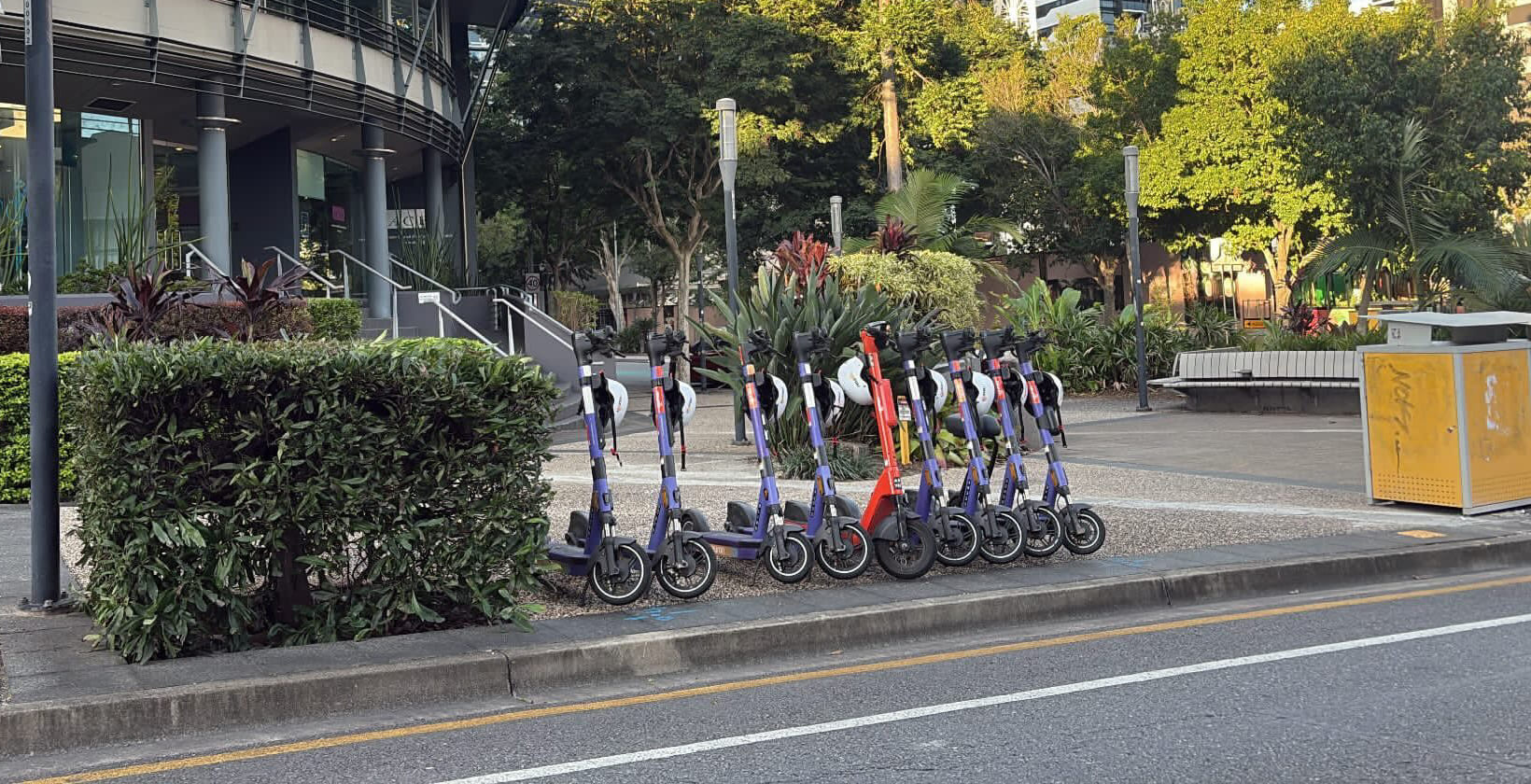
Shared e-scooters parked in a designated zone on Boundary Street, West End. Photo: Sam Colbey
Queensland introduced tougher e‑scooter and e‑bike laws on 1 July 2026 in response to rising injury numbers and community concern. The reforms increase penalties, ban devices capable of more than 25km/h, introduce drink‑riding enforcement, and make parents liable for fines when children under 16 ride illegally, with a rider licensing requirement to follow from 31 August 2026. The laws change the rules for riders, but they do not change how compensation works for people injured in e‑scooter accidents. Queensland’s Compulsory Third Party (CTP) insurance scheme still does not cover e‑scooters, which means injured pedestrians must claim through a different legal pathway.
This article explains the new rules, then covers what matters most for anyone injured in an e-scooter accident: who pays compensation, how the new laws affect proving fault, and the time limits that apply.
What are the new e-scooter laws in Queensland from 1 July 2026?
Queensland's new e-scooter laws form the largest change to personal mobility device regulation since e-scooters were legalised in the state. The new e-scooter laws in Queensland from 1 July 2026 introduce higher penalties for dangerous riding, a ban on devices capable of exceeding 25km/h, random breath testing for riders, new speed limits, police powers to seize illegal devices, and fines for parents whose children under 16 ride illegally.
The key changes now in force are:
Higher penalties for dangerous riding
Penalties increased for speeding, riding without a helmet, careless riding, carrying passengers, and riding e-scooters, e-skateboards or e-unicycles on prohibited roads. Passengers are banned on all personal mobility devices regardless of age or size, including parents doubling with children.
Device speed ban
Devices capable of travelling faster than 25km/h are banned. E-scooters and other personal mobility devices must be restricted so they cannot exceed 25km/h. E-bike motors are limited to assisting up to 25km/h, with higher speeds only permitted under pedal power. Police have the power to seize and, in some cases, destroy illegal devices.
Drink riding enforcement
Police now conduct random breath tests on riders of e-scooters, e-bikes and other personal mobility devices in public places. A general blood alcohol limit of 0.05 applies.
New speed limits
A 12km/h speed limit applies on footpaths and when passing pedestrians on shared paths. E-scooters, e-skateboards and e-unicycles are now permitted on roads with speed limits up to 60km/h, including on-road bike lanes. They may still only travel at the lower of the device limit or any local speed limit that applies.
Parental liability
Parents face a $518 fine when a child under 16 rides illegally. This includes riding an illegal device, riding underage, and riding unlicensed once the licensing requirement commences. Riders must be 16 or older to ride unsupervised, and children aged 12 to 15 are only permitted to ride under adult supervision.
What changes for Queensland e-scooter riders from 31 August 2026?
From 31 August 2026, Queensland will introduce licensing and age rules for e‑scooter riders as part of the new e‑mobility law reforms. In most public places, riders must be at least 16 years old and hold a valid driver licence (at minimum a learner licence) issued in Queensland or another Australian state or territory, or a recognised overseas equivalent.
The Government has indicated there will be limited exemptions for some riders who cannot hold a driver licence for medical reasons but are still assessed as able to safely operate an e‑scooter, and for certain controlled environments such as rail trails or mountain bike parks. The exact details of these exemptions and any designated riding areas will be confirmed in supporting regulations and guidance materials released closer to 31 August 2026, so riders should check the latest information from StreetSmarts and the Queensland Government before the new rules commence.
Do the new e-scooter laws change compensation rights for injured pedestrians in Queensland?
The new laws focus on rider behaviour and enforcement rather than insurance or compensation. The new e-scooter laws do not change compensation rights for injured pedestrians in Queensland, because e-scooters remain outside the Compulsory Third Party (CTP) insurance scheme.
Under the Motor Accident Insurance Act 1994, a motor vehicle is defined as a vehicle requiring registration under the Transport Operations (Road Use Management) Act 1995. E-scooters do not require registration, so they carry no CTP insurance. A pedestrian injured by a negligent e-scooter rider cannot claim through the CTP scheme the way a pedestrian struck by a car does. The injured pedestrian instead pursues a public liability claim directly against the rider or another responsible party.
This gap matters because e-scooter injuries continue to rise. More than 6,000 people presented to participating Queensland emergency departments as a result of e-scooter crashes between 2022 and 2025, with fractures, dislocations and head injuries among the most common injury types. These figures understate the true number, because not all hospitals contribute data and not everyone injured seeks treatment.
The insurance gap changes the defendant, the notice deadlines, the funding of any settlement, and the evidence required to recover compensation. These differences between the motor vehicle scheme and the public liability pathway shape every stage of pedestrian accident claims in Queensland.
How does an injured pedestrian claim compensation after an e-scooter accident in Queensland?
An injured pedestrian has compensation options even though Queensland’s compulsory third party (CTP) scheme generally does not cover e‑scooter‑only crashes. In most cases, an injured pedestrian pursues a public liability claim under the Personal Injuries Proceedings Act 2002 (Qld) against the e‑scooter rider and any other party whose negligence contributed to the accident, such as a hire scheme operator, a business or property owner, or a local council.
The right pathway depends on who was riding, what type of scooter they used, and where the crash happened. An injury lawyer will investigate all potential respondents and insurance policies, including any cover held by the rider, the hire scheme operator, or an occupier of the area where the collision occurred. Each of these factors determines the correct respondent, the available insurance, and the likely value of an e-scooter accident claim made in Queensland.
More information on each e-scooter claim pathway is below:
Claims against hire scheme operators
Shared e‑scooter operators such as Beam, Neuron and Lime typically arrange public liability insurance to cover their operations and the risks associated with their fleets. Whether that insurance responds to a pedestrian’s injury depends on the policy wording, including how it deals with rider negligence, contractual risk allocation in the user agreement, and any exclusions for particular types of use or locations.
From a practical perspective, claims involving hired scooters can be more viable than claims against private riders, because there is usually at least one commercial insurer in the frame rather than relying on an individual rider’s personal assets. However, operator terms and conditions often try to limit or shift liability onto riders, so a careful review of the contract and the operator’s insurance arrangements is essential in every case.
Claims against private riders
A pedestrian injured by a privately owned e-scooter claims against the rider personally. Some riders hold home and contents insurance with legal liability cover that responds to these claims. Where no insurance exists, recovery depends on the rider's personal financial position, which is a practical barrier in many claims. An experienced personal injury lawyer will investigate every available insurance policy and responsible party before advising on whether a claim is commercially viable.
Claims involving children and parents
The new parental liability fines naturally raise questions about whether parents can also be sued in negligence when their child causes an e‑scooter accident. In Queensland, a civil claim is still based on ordinary negligence principles rather than the fine itself, so the key issue is whether the parent failed to take reasonable care in supervising the child or in allowing them to use a particular device in particular circumstances.
In practice, this can include allegations that a parent allowed a child to ride an e‑scooter that was too powerful or illegal for public paths, failed to enforce helmet or speed rules, or let a young person ride unsupervised in a busy or clearly unsafe environment. If a court finds that a “reasonable parent” in the same position would have prevented the child from riding, insisted on supervision, or taken the device away, the parent can be found partly liable for the injuries the child causes.
The new offence provisions do not automatically make parents liable in negligence, but they are likely to be used as evidence about what reasonable care looks like. For example, if a parent is fined because their under‑16 child was riding illegally and that same incident injures a pedestrian, the breach of the offence provision may support an argument that the parent failed to take reasonable steps to stop the unlawful riding, even though the civil claim still has to be proved on its own facts.
Can an injured e-scooter rider claim compensation in Queensland?
An injured e‑scooter rider can claim compensation in Queensland if another person or organisation is legally at fault, or if the rider qualifies for workers compensation. A rider may have a claim where a negligent motor vehicle driver causes the crash (giving access to that driver’s CTP insurer), where a council, property occupier, event organiser or another rider/pedestrian is negligent (supporting a public liability claim), or where the rider is using the e‑scooter for work and is properly classified as a “worker” so they can claim through workers compensation. By contrast, a rider who is injured by their own fault, with no other negligent party and no unsafe defect in the environment, will usually have no compensation claim against another party, and the new e‑scooter laws do not alter that basic position.
The main pathways for claiming as a rider are further outlined below.
CTP claims against negligent drivers
A rider injured by a negligent motor vehicle driver claims against that driver's CTP insurer under the Motor Accident Insurance Act 1994, even though the e-scooter itself is uninsured. The same rules governing CTP claims in Queensland for injured cyclists and pedestrians apply to the rider, including the Notice of Accident Claim Form, the insurer's mandated response timeframes, and the structured pre-court process.
Workers compensation claims for delivery and gig riders
Riders who are injured while using an e‑scooter for work may be able to claim statutory workers compensation through WorkCover Queensland or another workers compensation insurer. That can include food delivery riders, couriers and other gig‑economy riders, provided they meet the legal tests to be treated as a “worker” rather than a genuinely independent contractor.
Whether a delivery rider is a worker is a fact‑specific question and depends on factors such as how much control the platform exerts over the rider, who provides the equipment, and how the contract is structured. In practice, some platform riders are accepted as workers and can access no‑fault statutory benefits, while others need to look to public liability or other insurance instead. An injury lawyer can review the contract and the work arrangements to work out if a workers compensation claim is available and whether any common law work injury damages claim can also be pursued.
Public liability claims
A rider injured by a road defect, a hazard on a shared path, or the negligence of another rider or pedestrian pursues a public liability claim against the responsible party, such as a local council or property occupier.
A rider injured solely through their own riding still has no claim against another party under the rule changes.
How do the new e-scooter laws affect proving negligence in an injury claim?
The new e‑scooter laws make it easier to prove negligence where a rider has clearly ignored the rules, but they don’t turn every breach into automatic civil liability. Every public liability claim still requires the injured person to show that another party breached their duty of care and caused the injury. However, when a rider breaks a safety rule that is clearly designed to protect other road and path users, that breach can be strong evidence that they failed to take reasonable care.
Riders who were speeding on a footpath, using an illegally modified device, riding underage, riding without the required licence after 31 August 2026, or riding over the 0.05 alcohol limit are likely to face an uphill battle defending a claim brought by someone they injure. The new rules give courts, insurers and lawyers clearer benchmarks for how a reasonable rider should behave, so it becomes easier to show that a rider’s conduct fell below that standard, even though negligence still has to be proved on the facts of each case rather than being assumed automatically from a breach.
The same logic works against injured riders who were themselves breaking the rules at the time of a crash. A rider who is hurt while riding illegally can expect the other side to argue contributory negligence, which reduces any compensation in line with the rider’s share of responsibility. In more serious cases – such as riding drunk, riding unlicensed or travelling at obviously unsafe speeds – the percentage deduction for contributory negligence can be substantial, because the rider has clearly increased the risk of harm to themselves. In that way, the new laws effectively raise the expected standard of care for riders in many situations and give insurers clearer grounds to argue that unsafe riding contributed to an injury.
What must riders do after an e-scooter crash under the new laws?
The new laws impose clear obligations at the scene of a crash. A rider involved in a crash with any person, including a pedestrian, cyclist or driver, must stop, remain at the scene, provide assistance to any injured person, and exchange contact details, with fines of up to $1,727 for minor incidents and up to $3,454 for serious incidents for failing to do so.
These obligations apply on all roads, footpaths, shared paths and bikeways. For injured people, this matters because identifying the rider is the essential first step in any claim. A pedestrian injured by a rider who leaves the scene should report the incident to police immediately and gather any available evidence, including witness details and nearby CCTV.
What are the time limits for e-scooter injury claims in Queensland?
Strict time limits apply to e-scooter injury claims, and they differ from motor vehicle claim deadlines. An e-scooter injury claim in Queensland must generally be started within three years of the accident under the Limitation of Actions Act 1974, with an initial notice of claim required much earlier under the Personal Injuries Proceedings Act 2002.
The Personal Injuries Proceedings Act 2002 requires an injured person to give the responsible party an initial notice within nine months of the accident, or within one month of consulting a lawyer, whichever is earlier. Missing these deadlines requires a reasonable excuse and creates avoidable risk. A rider injured by a motor vehicle instead follows the time limits for a car accident claim, which run from the Notice of Accident Claim Form deadlines under the Motor Accident Insurance Act 1994. Because these time limits can be complex and there are different for public liability and motor vehicle claims, injured riders and pedestrians should get legal advice as early as possible after an accident.
Get advice about an e-scooter injury claim
E-scooter injury claims involve a compensation pathway most people have never dealt with, and the right defendant is not always obvious. Gain Lawyers acts for injured pedestrians and riders across Queensland on a No Win No Fee basis. Contact us for a free case review, or use our injury compensation calculator to get an estimate of what your claim could be worth.