

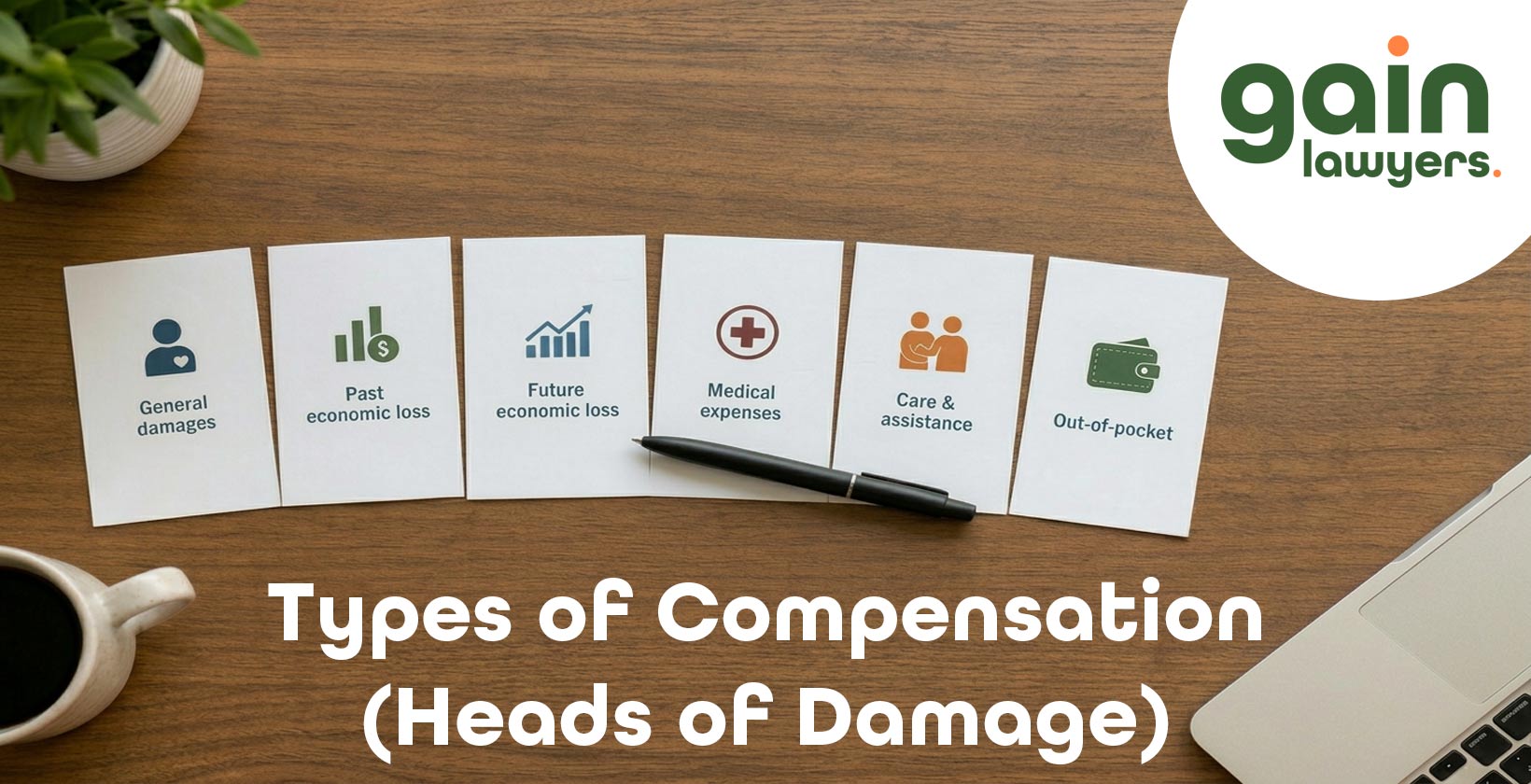
The individual types of compensation in a personal injury claim are legally referred to as 'heads of damage'. Heads of damage fall into two overarching categories, economic loss and non-economic loss. Economic loss covers the financial losses caused by the injuries, including lost earnings, medical expenses, care and assistance, and superannuation. Non-economic loss covers the non-financial impact of the injuries on the claimant's quality of life, including pain and suffering.
The 8 main compensation categories (heads of damage) in a Queensland personal injury claim are as follows.
- General damages. Compensation for pain, suffering, and loss of enjoyment of life caused by the injuries.
- Past economic loss. Income and financial benefits lost between the date of the accident and the date of settlement.
- Future economic loss. The projected reduction in earning capacity from settlement through to the end of the claimant's working life.
- Medical and rehabilitation expenses. The cost of all past and future medical treatment, therapy, and rehabilitation required as a result of the injuries.
- Care and assistance. The value of personal care, domestic help, and household services provided by paid professionals or unpaid family members and friends.
- Out-of-pocket expenses. Miscellaneous costs incurred as a direct result of the injuries, including travel, medication, aids, equipment, and home modifications.
- Loss of superannuation. Employer superannuation contributions lost during periods of reduced or lost earnings.
- Interest on past losses. Compensation for the time value of money the claimant has been without since the losses were incurred.
Heads of damage are the framework used to determine claim value, with each category assessed independently and combined into a total claim value. The maximum general damages payable in Queensland for claims on or after 1 July 2024 is $456,950, though general damages typically represent a smaller proportion of the total payout than economic loss in serious injury claims.
These heads of damage apply to all common law personal injury claims in Queensland, including Compulsory Third Party (CTP) motor vehicle accident claims, public liability claims, and medical negligence claims. Workers compensation claims operate under a separate statutory scheme with different entitlements, though injured workers who pursue a common law claim for employer negligence can access the same heads of damage.
Several factors affect the compensation you can claim, including the severity of the injuries, the claimant's earning capacity, and any reduction for contributory negligence. Compensation is also available for psychological injuries including chronic pain and nervous shock where supported by specialist medical evidence.
1. General damages
General damages is the component of personal injury compensation that covers pain, suffering, loss of amenity, and the reduction in quality of life caused by the injuries. Unlike economic loss (which compensates for financial losses that can be calculated in dollar terms), general damages compensates for the subjective, non-financial impact of the injuries on the claimant's daily life, relationships, and emotional wellbeing. General damages is sometimes referred to as "non-economic loss" or colloquially as "pain and suffering compensation".
General damages in Queensland are assessed using the Injury Scale Value (ISV) system established under the Civil Liability Act 2003 (Qld) and the Civil Liability Regulation 2025 (Qld), which replaced the Civil Liability Regulation 2014 (Qld) on 1 September 2025. The 2014 Regulation continues to apply to injuries that occurred before that date.
The ISV system assigns a number between 0 and 100 based on the claimant's dominant injury. A dominant injury is the single most serious injury the claimant sustained, which anchors the ISV assessment even where the claimant has multiple injuries. An ISV of 0 represents an injury not severe enough to attract general damages. An ISV of 100 represents the most catastrophic injuries such as quadriplegia or severe traumatic brain injury with total loss of independence. Each ISV number corresponds to a dollar range that is indexed annually on 1 July by the Queensland Government, and the ISV table that applies to a particular claim is determined by the date the injury occurred, not the date of settlement. The court or the parties determine where within the prescribed range the claimant's specific circumstances fall. The Injury Scale Value table sets out the item numbers for specific injury types and the corresponding ISV ranges used in this assessment.
The way the ISV assessment works in practice is that the claimant's lawyer identifies the relevant injury item number from the Civil Liability Regulation 2025, which lists hundreds of specific injuries organised by body region and injury type. Each item number has a prescribed ISV range. A simple wrist fracture that heals fully typically falls within a low ISV range, while more serious injuries such as amputations fall within the middle of the scale, and severe traumatic brain injuries requiring lifelong care fall within the highest end. Where the claimant has multiple injuries, the dominant injury sets the base ISV and the additional injuries may justify an uplift within or slightly above the prescribed range, depending on their combined impact on the claimant's life. The uplift for multiple injuries rarely exceeds 25% above the maximum ISV for the dominant injury.
The evidence required to prove general damages in a Queensland personal injury claim includes medical reports establishing the diagnosis, severity, and permanence of each injury, a Whole Person Impairment (WPI) assessment expressed as a percentage of permanent bodily impairment assessed against standardised medical guidelines, and the treating doctors' opinions on the prognosis for future recovery. Medical experts assess the injuries and the degree of impairment but do not assign the ISV itself. The ISV is determined by the court or agreed between the parties' lawyers during settlement negotiations. The claimant's own evidence is also critical. The claimant typically provides a statement describing how the injuries have affected their ability to work, participate in hobbies and sport, maintain social relationships, care for their children or family members, sleep, drive, exercise, and carry out everyday household tasks. This evidence personalises the ISV assessment and helps distinguish between two claimants with the same injury but very different impacts on their lives.
Psychological consequences of the physical injuries are assessed as part of general damages where they are supported by psychiatric evidence. Depression, anxiety, adjustment disorder, and post-traumatic stress disorder commonly develop after serious accidents, particularly where the claimant experiences chronic pain, loss of independence, or inability to return to work. A psychiatrist's report establishing a diagnosed condition caused by the accident can significantly increase the ISV assessed for the claim, because the psychological injury may become the dominant injury or justify an uplift above the range prescribed for the physical injury alone.
Not all injuries qualify for general damages in Queensland. The Civil Liability Act 2003 (Qld) imposes a threshold requiring the injury to reach a minimum level of severity before general damages become payable. Injuries that fall below this threshold (typically very minor soft tissue injuries that resolve completely within a few weeks without ongoing symptoms) do not attract any general damages at all, though the claimant may still recover economic loss and medical expenses for those injuries. This threshold is one of the most common sources of confusion for claimants with minor injuries who expect compensation for pain and suffering but find their injury does not meet the statutory minimum.
General damages often represents a smaller proportion of the total compensation than most claimants expect. In the Queensland Supreme Court case of Reddock v ST&T Pty Ltd [2022] QSC 293, general damages of $45,500 represented approximately 6% of the total award of $727,000, while future economic loss accounted for approximately 58%. This pattern is typical in serious injury claims where economic loss dominates the total payout. For minor to moderate injuries where the claimant has limited economic loss, general damages may represent the largest single component. The maximum general damages payable in Queensland for claims on or after 1 July 2024 is $456,950, though this figure is reserved for the most catastrophic injuries at the top of the ISV scale and the vast majority of claims settle for significantly less.
These general damages rules apply to Compulsory Third Party (CTP) motor vehicle accident claims and public liability claims. Different assessment methods and caps apply to workplace injuries under the Workers' Compensation and Rehabilitation Act 2003 (Qld).
2. Past economic loss
Past economic loss in a personal injury claim is the income, earnings, and financial benefits the claimant has lost between the date of the accident and the date of settlement or judgment. Past economic loss is often one of the largest components of a personal injury compensation payout because it captures every dollar the claimant would have earned if the accident had not occurred, including base salary, overtime, bonuses, commissions, allowances, and employer superannuation contributions.
Past economic loss is calculated by comparing the claimant's actual post-accident earnings to what they would have earned if the accident had not happened. For an employed person, this comparison is relatively straightforward. The claimant's pre-accident payslips, tax returns, and employer records establish a baseline earning rate, and the difference between that baseline and what the claimant actually earned (or could have earned) during the period of incapacity is the past economic loss. For self-employed claimants, the calculation is more complex and typically requires a forensic accountant to analyse business financial statements, tax returns, and profit trends to isolate the income reduction attributable to the injuries.
The evidence required to prove past economic loss includes payslips and payment summaries for the 12 to 24 months before the accident, tax returns (usually three years), employer statements confirming the claimant's role, hours, pay rate, and any promotions or pay increases that were expected, superannuation contribution records, and medical evidence establishing the period during which the claimant was unable to work or had reduced work capacity. Where the claimant returned to work in a lower-paying role or on reduced hours due to the injuries, the difference between their pre-accident earnings and their reduced post-accident earnings is still recoverable as past economic loss.
Past economic loss in a Queensland personal injury claim also includes the loss of employer superannuation contributions during the period of incapacity. Superannuation is calculated at the applicable Superannuation Guarantee rate applied to the lost wages figure. This component is frequently overlooked by claimants but can add tens of thousands of dollars to the claim in cases involving lengthy periods off work.
A related but distinct component of past economic loss is the Fox v Wood component. The Fox v Wood component is a tax adjustment that accounts for the difference between the claimant's gross lost earnings and the tax they would have paid on those earnings, ensuring the compensation reflects actual take-home pay rather than an inflated gross figure. The principle takes its name from the High Court of Australia decision that established this approach.
Past economic loss is typically easier to prove than future economic loss because it relies on historical records rather than projections. However, disputes commonly arise where the insurer or defendant argues that the claimant could have returned to work earlier than claimed, that the claimant failed to mitigate their loss by not seeking suitable alternative employment, or that pre-existing conditions rather than the accident caused some of the lost earnings. Strong medical evidence linking the period of incapacity directly to the injuries sustained in the accident is essential to defending against these arguments. The total past loss figure in a personal injury claim combines the base lost earnings, the Fox v Wood tax adjustment, superannuation loss, and interest. Disputes over past economic loss most commonly arise around the duration of incapacity and whether the claimant took reasonable steps to return to work.
3. Future economic loss
Future economic loss in a personal injury claim is the reduction in the claimant's earning capacity from the date of settlement or judgment through to the end of their expected working life, expressed as a lump sum. Future economic loss is frequently the single largest component of a serious personal injury claim because it captures decades of lost or reduced earnings where the injuries permanently affect the claimant's ability to work at their pre-accident level.
Future economic loss differs from past economic loss in an important way. Past economic loss compensates for income already lost, which can be calculated from actual records. Future economic loss compensates for income the claimant is projected to lose in the future, which requires assumptions about what the claimant would have earned if the accident had not happened and what they are now capable of earning with the injuries. This inherent uncertainty makes future economic loss the most heavily contested component in most personal injury claims.
The standard method for calculating future economic loss in Queensland is to determine the weekly difference between the claimant's pre-accident earning capacity and their post-accident residual earning capacity, then multiply that weekly difference by a present value multiplier derived from standardised discount tables. The discount tables apply a prescribed statutory discount rate to convert the projected future loss into a lump sum that reflects the investment value of receiving the money upfront rather than as weekly earnings over time. Future economic loss is calculated on a net (after-tax) basis, reflecting the actual take-home pay the claimant would have received, which differs from past economic loss where the gross figure is used and a separate tax adjustment (the Fox v Wood component) is applied. The projected figures involve assumptions about career trajectory, residual work capacity, and life expectancy that are inherently uncertain, which is why future economic loss is the head of damage most frequently contested by insurers.
After the present value calculation, Queensland courts typically apply a further reduction for "contingencies" or "vicissitudes of life". Contingencies account for the possibility that factors unrelated to the accident (such as economic downturns, periods of unemployment, illness, or career changes) might have affected the claimant's earnings regardless of the accident. This deduction is separate from the discount rate and is applied to the discounted figure.
The evidence required to prove future economic loss is more complex than for past economic loss. The claimant must establish both what they would have earned without the accident and what they are now capable of earning with the injuries. Pre-accident earning trajectory is established through employment records, qualifications, career progression history, and evidence of planned promotions, pay increases, or career changes. Post-accident residual earning capacity is assessed through medical evidence about the claimant's physical and cognitive work restrictions, vocational assessments evaluating what occupations the claimant can realistically perform, and (where relevant) evidence of any retraining or re-education the claimant has undertaken or could undertake.
Forensic accountants are commonly engaged in serious personal injury claims to prepare detailed future economic loss reports. A forensic accountant models the claimant's projected pre-accident earnings trajectory (including wage growth, superannuation contributions at the current Superannuation Guarantee rate of 12%, and career progression) and compares it against the projected post-accident earnings trajectory based on the medical and vocational evidence. The resulting report typically presents a range of loss scenarios reflecting different assumptions about the claimant's residual work capacity.
Where the claimant's future earnings trajectory is too uncertain for precise mathematical calculation, courts may award a global sum based on a broad assessment of diminished earning capacity rather than a week-by-week calculation. Global sum assessments are more common for young claimants early in their careers, self-employed claimants with variable income, and claimants whose career trajectory was genuinely unclear at the time of the accident.
Several factors complicate the assessment of future economic loss. Young claimants with decades of working life remaining produce significantly larger figures than older claimants approaching retirement. Claimants with high pre-accident incomes produce larger loss figures than those in lower-paid roles. Self-employed claimants face additional complexity because their future earnings are inherently less predictable. The insurer or defendant commonly disputes future economic loss by arguing that the claimant retains greater residual earning capacity than claimed or that the contingencies deduction should be higher than standard.
Unlike past economic loss, future economic loss does not attract interest because the lump sum is calculated as a present value figure that already accounts for the time value of money.
4. Medical and rehabilitation expenses
Medical and rehabilitation expenses in a personal injury claim are the costs of all medical treatment, therapy, and rehabilitation the claimant has required and will continue to require as a result of the injuries. Medical expenses are divided into past medical expenses (costs already incurred between the accident and settlement) and future medical expenses (projected costs of ongoing treatment after settlement), and both are recoverable as separate components of the compensation payout.
Past medical expenses are the more straightforward component. The claimant compiles receipts, invoices, and Medicare statements for every medical cost incurred since the accident, including general practitioner consultations, specialist appointments, hospital admissions and surgeries, diagnostic imaging (MRI, CT, X-ray), physiotherapy and exercise physiology, psychological and psychiatric treatment, prescription medication, dental treatment for accident-related injuries, and ambulance transport. Where Medicare or private health insurance has covered part of the cost, the compensation claim recovers the gap between what the claimant paid out of pocket and any outstanding Medicare or insurer liens that must be repaid from the settlement.
Future medical expenses require expert evidence projecting what treatment the claimant will need for the rest of their life, or for the remaining duration of the injury's effects. The treating specialists and independent medical examiners provide opinions on the likely course of future treatment, including ongoing specialist reviews, medication, physiotherapy maintenance programs, future surgeries (such as joint replacements that may be needed in 10 to 20 years), psychological treatment, pain management programs, and any aids or equipment the claimant will need. A life care planner or occupational therapist may be engaged in serious injury claims to prepare a comprehensive future treatment plan that itemises every projected cost and the frequency of each treatment over the claimant's remaining life expectancy.
The standard applied to medical expenses in a Queensland personal injury claim is that the treatment must be "reasonable and necessary". The insurer or defendant is not required to fund treatment that is excessive, experimental, or unrelated to the injuries caused by the accident. Disputes about the reasonableness of medical treatment are common, particularly where the claimant seeks expensive or ongoing treatment that the insurer's independent medical examiner considers unnecessary. Contemporaneous treating doctor records, specialist referral letters, and diagnostic imaging results form the core medical evidence used to establish that each treatment episode was directly connected to the accident injuries and clinically appropriate.
An important practical point is that in Queensland motor vehicle accident claims, insurers typically fund reasonable and necessary rehabilitation treatment during the claim, even before liability has been formally admitted. This means the claimant can access physiotherapy, psychology, and other rehabilitation services while the claim is still being investigated, without waiting for the claim to settle. This early rehabilitation funding can significantly improve recovery outcomes by ensuring treatment begins promptly rather than being delayed by the claims process.
Future medical expenses are calculated on a present value basis using the same discount rate applied to future economic loss. The projected annual cost of future treatment is multiplied by the relevant period (either the claimant's remaining life expectancy or the expected duration of the treatment need) and discounted to a lump sum. For claimants with lifelong treatment needs (such as those with spinal cord injuries, traumatic brain injuries, or chronic pain conditions), future medical expenses can represent a substantial component of the total compensation, sometimes rivalling or exceeding the future economic loss figure.
5. Care and assistance
Care and assistance compensation in a personal injury claim covers the value of personal care, domestic help, and household services the claimant requires as a result of the injuries, whether that care is provided by paid professionals or unpaid family members and friends. Care and assistance is one of the most commonly undervalued components of a personal injury claim because many claimants do not realise that the help they receive from family members has a compensable dollar value.
Care and assistance in Queensland personal injury claims falls into two categories. The first is paid commercial care, where the claimant engages professional carers, cleaners, gardeners, or other service providers to perform tasks they can no longer manage due to their injuries. Paid care is claimed at the actual cost incurred, supported by invoices and receipts. The second is gratuitous care, which is care provided by family members, partners, friends, or other unpaid people. Gratuitous care is compensable under section 59 of the Civil Liability Act 2003 (Qld), which entitles the claimant to recover the commercial value of unpaid care provided by others, even though no money actually changed hands.
Gratuitous care under section 59 is subject to specific thresholds and requirements. The care must have been provided for at least 6 hours per week for at least 6 consecutive months, and the need for the care must arise from the injuries sustained in the accident. The value of gratuitous care is assessed at commercial rates for equivalent services (for example the hourly rate a commercial cleaner or in-home carer would charge for the same tasks), not at the actual cost to the person providing the care (which is zero). This means a spouse who takes time off work to care for the injured claimant, drives them to medical appointments, helps them shower and dress, and takes over all household cooking and cleaning generates a gratuitous care claim valued at what those services would cost if purchased commercially.
The types of care and assistance commonly claimed in Queensland personal injury claims include personal care (showering, dressing, toileting, mobility assistance), domestic assistance (cooking, cleaning, laundry, grocery shopping), home maintenance (mowing, gardening, minor repairs), childcare assistance (where the claimant's injuries prevent them from caring for their children at their pre-accident level), and transport to medical and rehabilitation appointments. Each category is assessed separately and valued at the applicable commercial rate.
The evidence required to prove care and assistance includes detailed care logs maintained by the claimant and the care providers, documenting the type of assistance provided, the hours spent, and the dates on which the care was given. Occupational therapy reports are commonly used to assess the claimant's functional limitations and the specific care needs arising from those limitations. The occupational therapist provides an independent assessment of what tasks the claimant can and cannot perform, and recommends the type and hours of care required both currently and into the future.
Future care and assistance is calculated on a present value basis using the same discount methodology applied to future economic loss. Where the claimant's injuries are permanent and their care needs are expected to continue for life (such as in spinal cord injury, severe traumatic brain injury, or multiple limb amputation), future care and assistance can become one of the largest single components of the total compensation, potentially running into millions of dollars for catastrophic injuries requiring round-the-clock professional care.
6. Out-of-pocket expenses
Out-of-pocket expenses in a personal injury claim are the miscellaneous costs the claimant incurs as a direct result of the injuries that do not fall within the major heads of damage such as medical expenses, economic loss, or care and assistance. Out-of-pocket expenses are sometimes referred to as "special damages" alongside medical expenses and economic loss, and while each individual item is usually modest, the cumulative total across a claim lasting several years can be significant.
The types of out-of-pocket expenses commonly claimed in Queensland personal injury claims include the following.
- Travel costs for medical and rehabilitation appointments (fuel, tolls, parking, public transport fares, or taxi and rideshare fares where the claimant cannot drive)
- Medication costs not fully covered by the Pharmaceutical Benefits Scheme or private health insurance
- Medical aids and equipment (crutches, braces, orthotics, wheelchair hire, TENS machines, heat packs)
- Home modifications required as a result of the injuries (grab rails, ramps, shower chairs, stair lifts)
- Clothing and footwear damaged in the accident or required to accommodate injuries (such as specialist footwear after a foot injury)
- Dietary supplements or special dietary requirements prescribed as part of the treatment plan
- Postage, printing, and administrative costs associated with the claim
Out-of-pocket expenses are claimed at actual cost and must be supported by receipts, invoices, or bank statements. The claimant should keep every receipt from the date of the accident, no matter how small, because the insurer will require documentary evidence for each item claimed. A practical approach is to maintain a dedicated folder or envelope for accident-related receipts and to photograph receipts on a phone as a backup in case the paper copies fade or are lost.
Future out-of-pocket expenses can also be claimed where the claimant's injuries will require ongoing expenditure after settlement. Common examples include long-term medication costs, replacement of medical aids and equipment at regular intervals, and ongoing travel costs for specialist appointments. Future out-of-pocket expenses are calculated on a present value basis and included in the total lump sum.
7. Loss of superannuation
Loss of superannuation in a personal injury claim is the superannuation contributions the claimant's employer would have made during the period of lost earnings, which the claimant loses because they were unable to work due to the injuries. Loss of superannuation applies to both past economic loss (contributions lost between the accident and settlement) and future economic loss (contributions the claimant will miss out on over their remaining working life).
Superannuation loss is calculated by applying the current Superannuation Guarantee rate to the assessed economic loss figure. A claimant with assessed past economic loss of $150,000, for example, would have a past superannuation loss of over $17,000 on top of the lost earnings figure. For future economic loss, the superannuation component is calculated on the discounted future earnings figure using the same present value methodology.
Loss of superannuation is treated as a separate line item in the damages calculation rather than being rolled into the economic loss figure. This distinction matters because superannuation is money the claimant would never have received as take-home pay during their working life. It would have been paid directly into their superannuation fund by their employer and only accessed at retirement. The compensation for lost superannuation is paid to the claimant as part of the lump sum settlement, not into a superannuation fund, which means the claimant receives it immediately but loses the benefit of decades of compound investment growth that the contributions would have generated inside the fund.
Self-employed claimants can also claim loss of superannuation where they can demonstrate a consistent pattern of making voluntary superannuation contributions before the accident. The evidence required is typically superannuation fund statements and tax returns showing regular contributions in the years preceding the accident.
Loss of superannuation is frequently overlooked by unrepresented claimants who focus on lost wages and medical expenses without realising that the employer superannuation contributions they missed are a separately claimable head of damage. Queensland courts sometimes state superannuation as a separate line item and sometimes include it within the future economic loss figure. In the Queensland Supreme Court case of Murphy v Madill, future superannuation loss was assessed at $129,599 within a total damages award of approximately $1.37 million. In serious injury claims involving decades of future economic loss, the superannuation component alone can add hundreds of thousands of dollars to the total compensation.
8. Interest on past losses
Interest on past losses in a personal injury claim is a component of compensation that accounts for the time value of money the claimant has been without since the losses were incurred. Interest compensates the claimant for the fact that they have been out of pocket for medical expenses, lost earnings, and other costs for months or years while the claim has been progressing, and that money would have earned returns if it had been available to them during that period.
Interest in Queensland personal injury claims is payable on past economic loss, past medical expenses, and past out-of-pocket expenses. Interest is not payable on future losses because future losses are already calculated on a present value basis using the statutory discount rate, which accounts for the time value of money in the opposite direction. Two important exclusions apply. Interest is not payable on general damages under section 60(1)(a) of the Civil Liability Act 2003 (Qld), and interest is not payable on gratuitous care and assistance provided by family members or friends under section 60(1)(b), even where the past gratuitous care claim involves years of unpaid care.
Interest is calculated using prescribed rates and applied to past losses from the date each loss was incurred through to the date of settlement or judgment. In claims that take several years to resolve, interest on past economic loss can add a meaningful amount to the total compensation. While interest is a smaller component than the major heads of damage, it is money the claimant is entitled to and should not be overlooked.
What are heads of damage?
Heads of damage are the categories of loss for which compensation is recoverable in a personal injury claim, broken down into non-economic loss (pain and suffering, loss of amenity) and economic loss (medical expenses, lost income, care and assistance), with each category further divided into past loss and future loss.
The term is the legal profession's terminology for what claimants commonly call types of compensation. Each head of damage represents a distinct category of loss that must be separately quantified and proven, and the total compensation a claimant receives is the sum of the amounts awarded under each applicable head.
General damages compensate the claimant for non-economic loss, including pain and suffering, loss of amenity of life, and loss of expectation of life, calculated under the Injury Scale Value (ISV) framework in Schedule 4 of the Civil Liability Regulation 2025 (Qld). Past economic loss compensates the claimant for income already lost between the date of injury and the date of settlement, calculated from payslips, tax returns, and employer evidence of pre-injury earnings. Future economic loss compensates the claimant for income that will be lost from the date of settlement onward due to ongoing impairment of earning capacity, calculated by reference to the claimant's pre-injury earning trajectory and the medical evidence of future work capacity. Past medical and rehabilitation expenses compensate the claimant for treatment costs already incurred, including hospital fees, specialist consultations, surgery, physiotherapy, psychology, and pharmaceutical costs. Future medical and rehabilitation expenses compensate the claimant for treatment costs reasonably expected to be incurred in the future, supported by medical evidence forecasting ongoing care needs. Past care and assistance compensates the claimant for support already provided during the recovery period, whether commercial care from paid providers or gratuitous care from family members. Future care and assistance compensates the claimant for support reasonably required in the future, calculated at hourly rates set by reference to commercial care provider rates. Loss of superannuation entitlements compensates the claimant for employer superannuation contributions lost as a result of past and future loss of earnings.
Lawyers, insurers, and judges use the term "heads of damage" because each category requires separate evidence and separate calculation. The dollar value awarded under each head depends on how personal injury compensation is calculated, with the calculation drawing on the claimant's medical evidence, financial records, and the statutory framework that applies to that specific head of damage. A claim that recovers $500,000 in total compensation might break down across six or seven heads, with future economic loss typically the largest component in serious injury matters and general damages the largest in less severe ones.
How much compensation can you claim for a personal injury in Queensland?
The total compensation in a personal injury claim in Queensland varies widely depending on the severity of the injuries, the claimant's age and earning capacity, the length of time off work, the cost of ongoing medical treatment, and any contributory negligence reduction.
Type of claim is not as significant in determining claim value, the severity of injury is what is most important. The total compensation a claimant receives is the combined value of each head of damage assessed for that claimant's specific circumstances, paid as a single lump sum.
Average compensation payouts in Queensland vary significantly by injury severity. Minor injury claims involving soft tissue injuries and short-term recovery typically settle for approximately $82,000 in total compensation. Moderate injury claims average approximately $183,000. Serious injury claims involving long-term impairment average approximately $359,000. Severe injury claims involving life-altering injuries such as serious spinal or brain injuries average approximately $637,000. Catastrophic injury claims requiring lifetime care can exceed $1.5 million and in some cases reach several million dollars. These figures represent scheme-wide average payouts and individual outcomes vary widely depending on the claimant's specific losses.
The case of Reddock v ST&T Pty Ltd [2022] QSC 293 illustrates how the heads of damage combine in a serious injury claim. The Queensland Supreme Court awarded total damages of approximately $727,000, comprising general damages of $45,500 (approximately 6% of the total), past economic loss of $140,000 (approximately 19%), and future economic loss including superannuation of $421,000 (approximately 58%). The remaining components covered medical expenses, care, and other losses. This breakdown demonstrates the typical pattern in serious injury claims where future economic loss dominates the total payout and general damages represents a comparatively small proportion.
Can you calculate your personal injury compensation online?
Yes, personal injury compensation can be estimated online using compensation calculators that apply current Queensland legislative figures to the claimant's injury type, severity, and financial losses. These tools estimate each head of damage individually and combine them into a total claim range, including general damages, past and future economic loss, superannuation, gratuitous care, special damages, and interest. A compensation calculator that applies the Injury Scale Value (ISV) system and statutory reductions can provide a rough indication of potential claim value, but the estimates are extremely approximate.
The range of possible outcomes for any personal injury claim is enormous. Two claimants with the same injury type can receive vastly different compensation depending on their age, earning capacity, career trajectory, medical prognosis, quality of evidence, insurer conduct, and whether contributory negligence applies. Online calculators require the user to select injury severity and input financial details without the benefit of medical evidence, legal assessment, or understanding of how insurers actually value claims. The result is a broad indicative range, not a reliable estimate of what the claim will settle for. Calculator results are most useful as a starting point for understanding how heads of damage combine, not as a substitute for professional legal advice.
What can reduce the compensation you receive?
Several factors can reduce the total compensation in a personal injury claim, including the claimant's own contribution to the accident, pre-existing medical conditions, settling before injuries have fully stabilised, and the assessed level of permanent impairment. Each of these factors is applied during the damages assessment and can significantly affect the final payout.
Contributory negligence
Contributory negligence is a percentage reduction applied to the total compensation where the claimant's own actions contributed to the accident or the severity of the injuries. Common examples of contributory negligence include not wearing a seatbelt, jaywalking, riding without a helmet, or being a voluntary passenger with an intoxicated driver. A finding of 20% contributory negligence reduces every head of damage by 20%, which in a serious injury claim worth $500,000 would reduce the total payout by $100,000. Contributory negligence does not prevent the claimant from making a claim. It reduces the compensation proportionally, meaning even a claimant found to be 50% at fault can still recover half of their assessed damages.
Maximum medical improvement
Maximum medical improvement (MMI) is the point at which the claimant's injuries have stabilised and their long-term effects can be properly assessed by medical specialists. It does not directly reduce compensation, but settling a claim before reaching Maximum Medical Improvement risks significantly undervaluing it because the full extent of future medical needs, future earning capacity, and permanent impairment is unknown before that point. Insurers frequently make early settlement offers to claimants who have not yet reached MMI, and these offers are almost always lower than the amount the claimant would receive if they waited for the full medical picture to become clear. Most claimants reach MMI between 12 months and 3 years after the accident, though psychological injuries, chronic pain conditions, and injuries requiring staged surgical interventions often take considerably longer. The claimant's treating doctors and independent medical examiners provide opinions on whether MMI has been reached, and experienced personal injury lawyers will not recommend settling a claim until there is consensus that the injuries have stabilised.
Whole Person Impairment (WPI)
Whole Person Impairment (WPI) is a standardised percentage score assessing the degree of permanent bodily impairment resulting from the injuries, expressed as a percentage of the whole body. A WPI of 0% means no measurable permanent impairment, while assessments approaching 100% are reserved for the most catastrophic injuries. A Whole Person Impairment is assessed by qualified medical specialists using the American Medical Association Guides, which provide detailed criteria for rating impairment across every body system. The WPI assessment directly influences the Injury Scale Value (ISV) assigned to the claim, which determines the general damages component of the compensation. A higher WPI generally corresponds to a higher ISV and therefore higher general damages. Disputes over WPI assessments are common, with the claimant's medical experts and the insurer's medical experts frequently producing different ratings for the same injuries.
Can you claim compensation with a pre-existing condition?
Yes, you can claim compensation with a pre-existing condition in Queensland, but the compensation is limited to the extent that the accident worsened or aggravated the pre-existing condition beyond its natural trajectory. Queensland law recognises that many people live with existing health conditions and that an accident can make those conditions significantly worse.
The legal principle applied in Queensland is known as the "eggshell skull" rule, which means the defendant takes the claimant as they find them. A person with a pre-existing degenerative spinal condition who suffers a disc injury in a car accident is entitled to claim for the full extent of their post-accident symptoms, even if a person without the pre-existing condition would have recovered more quickly.
Full disclosure of pre-existing conditions is essential. Claimants who fail to disclose a prior injury or condition risk serious damage to their credibility if the insurer discovers the omission through medical records or Medicare history. The impact of pre-existing conditions on a personal injury claim depends on whether the condition was symptomatic before the accident, with entirely asymptomatic conditions generally treated more favourably than conditions already causing pain or time off work. Full disclosure does not weaken the claim, it allows the claimant's lawyers and medical experts to properly frame the aggravation argument.
Can you claim compensation for psychological injury?
Yes, you can claim compensation for psychological injury in Queensland provided the condition is diagnosed by a qualified psychiatrist or psychologist and is causally linked to the accident. Psychological injuries are assessed alongside physical injuries and can significantly increase the total compensation where the condition is severe or long-lasting, affecting general damages through a higher ISV, economic loss through reduced work capacity, and medical expenses through the cost of ongoing psychiatric treatment.
The most common psychological injuries claimed in Queensland personal injury matters include post-traumatic stress disorder (PTSD), major depressive disorder, generalised anxiety disorder, adjustment disorder, and specific phobias such as driving phobia after a serious car accident. Proving a psychological injury claim requires a formal diagnosis from a psychiatrist supported by a detailed medico-legal report establishing that the condition was caused by the accident rather than by pre-existing mental health issues or unrelated life stressors.
Can you claim compensation for chronic pain?
Yes, in Queensland you can claim compensation for chronic pain that develops as a result of accident injuries where it is supported by medical evidence establishing the diagnosis, its connection to the accident, and its impact on the claimant's functioning and quality of life. Chronic pain is defined medically as pain that persists beyond the normal healing period for the underlying injury, typically longer than 3 to 6 months.
Common chronic pain conditions arising from accidents include chronic lower back pain following spinal injuries, complex regional pain syndrome (CRPS), chronic neck pain and headaches following whiplash injuries, and neuropathic pain from nerve damage. Chronic pain affects compensation across several heads of damage, increasing general damages through a higher ISV, future medical expenses through the cost of long-term pain management, and future economic loss where the pain prevents return to pre-accident work. Insurers frequently challenge chronic pain claims because the subjective nature of pain makes it difficult to verify through objective testing.
Can you claim compensation for nervous shock?
Yes, you can claim compensation for nervous shock in Queensland. Nervous shock is a recognised basis for a personal injury claim where a person suffers a diagnosed psychiatric injury as a result of witnessing or learning about a traumatic event involving a close family member. Nervous shock claims are distinct from psychological injury claims because the claimant is not the person who was physically injured in the accident, but a secondary victim who suffers psychiatric harm as a consequence of what happened to someone else.
The Civil Liability Act 2003 (Qld) requires the claimant to have a recognised close relationship with the primary victim (typically a spouse, parent, child, or sibling) and to have suffered a diagnosed psychiatric condition rather than ordinary grief or emotional distress. Compensation in a nervous shock claim covers the same heads of damage as any personal injury claim, including general damages, economic loss, and the cost of ongoing psychiatric treatment.
Do heads of damage apply to workers compensation claims?
The heads of damage covered in this article apply to workers compensation claims only where the injured worker pursues a common law claim for negligence against their employer, not to the statutory entitlements available under the Workers' Compensation and Rehabilitation Act 2003 (Qld). Workers compensation in Queensland operates as two parallel systems, and the compensation available depends on which pathway the injured worker follows.
Workers compensation under the Workers' Compensation and Rehabilitation Act 2003 (Qld) is a statutory no-fault scheme. Injured workers receive weekly payments replacing a portion of lost wages, coverage of reasonable medical and rehabilitation expenses, and a lump sum payment for permanent impairment assessed against a statutory scale. These entitlements are available regardless of who caused the workplace injury, and the worker does not need to prove that their employer was negligent. The trade-off is that the statutory payments are generally lower than common law damages, particularly for future economic loss and general damages.
Common law compensation requires the injured worker to prove that their employer (or another party) was negligent and that the negligence caused the injury. A successful common law claim gives access to the full range of heads of damage covered in this article, including general damages, past and future economic loss, medical expenses, and care and assistance. The workers compensation claims process for pursuing common law damages involves electing to give up ongoing statutory weekly payments, which is a critical strategic decision that affects both the statutory entitlements and the total common law claim value.
Do the same heads of damage apply to all types of personal injury claim?
Yes, the same broad categories of heads of damage apply across the four most common types of personal injury claim in Queensland, comprising motor vehicle accident claims, workers' compensation claims, public liability claims, and medical negligence claims.
Each scheme modifies the heads of damage by statute, with different caps, thresholds, and offsets producing different end figures depending on which scheme governs the claim. Motor vehicle accident claims under the Motor Accident Insurance Act 1994 (Qld), public liability claims, and medical negligence claims under the Personal Injuries Proceedings Act 2002 (Qld) recover heads of damage subject to the Injury Scale Value framework for general damages and standard common-law principles for economic loss and care and assistance. Workers' compensation common law claims under the Workers' Compensation and Rehabilitation Act 2003 (Qld) recover the same heads but with WCRA-specific caps and offsets, and statutory workers' compensation benefits run alongside any common law claim through a separate entitlement track that provides defined weekly compensation, medical expenses, and lump sum impairment payments without reference to heads of damage. The specific types of personal injury claims recognised in Queensland (such as motor vehicle claims, public liability and workers compensation) determine which scheme applies, which statutory caps and thresholds modify the recovery, and which evidentiary requirements the claimant must satisfy to establish each head.
What are exemplary and aggravated damages in a personal injury claim?
Exemplary and aggravated damages are additional categories of compensation available in rare personal injury cases where the defendant's conduct was particularly egregious, reckless, or deserving of punishment beyond ordinary compensatory damages. These damages are not available in most personal injury claims and are awarded by courts only in exceptional circumstances.
Exemplary damages (sometimes called punitive damages) are designed to punish the defendant and deter similar conduct in the future, rather than to compensate the claimant for a specific loss. Exemplary damages may be awarded where the defendant's conduct was deliberate, high-handed, or showed a conscious disregard for the claimant's safety. Examples in a personal injury context include an employer who knowingly exposed workers to a dangerous substance without providing safety equipment, or a driver who caused an accident through extreme reckless conduct such as street racing or deliberate road rage.
Aggravated damages compensate the claimant for additional hurt, humiliation, or distress caused by the way the defendant behaved after the injury occurred. Aggravated damages differ from exemplary damages because they are compensatory rather than punitive. They may be awarded where the defendant's post-incident conduct made the claimant's experience significantly worse, such as an insurer acting in bad faith during the claims process or a defendant showing no remorse and attempting to blame the claimant despite clear evidence of fault.
Both exemplary and aggravated damages are subject to restrictions under the Civil Liability Act 2003 (Qld) and are not available in all claim types. Courts award them sparingly and the amounts are typically modest compared to the compensatory damages in the claim. Claimants should not expect exemplary or aggravated damages in a standard personal injury claim, but they remain an important remedy in cases involving genuinely outrageous conduct.